
VPS vs VDS: What’s the Difference?
If you're looking for a virtual server, you've probably seen two terms: VPS and VDS.
But what is the actual difference between VPS and VDS? Is VDS better than VPS? And which one should you choose?
Let's break it down in simple terms.
What Is VPS?
VPS stands for Virtual Private Server.
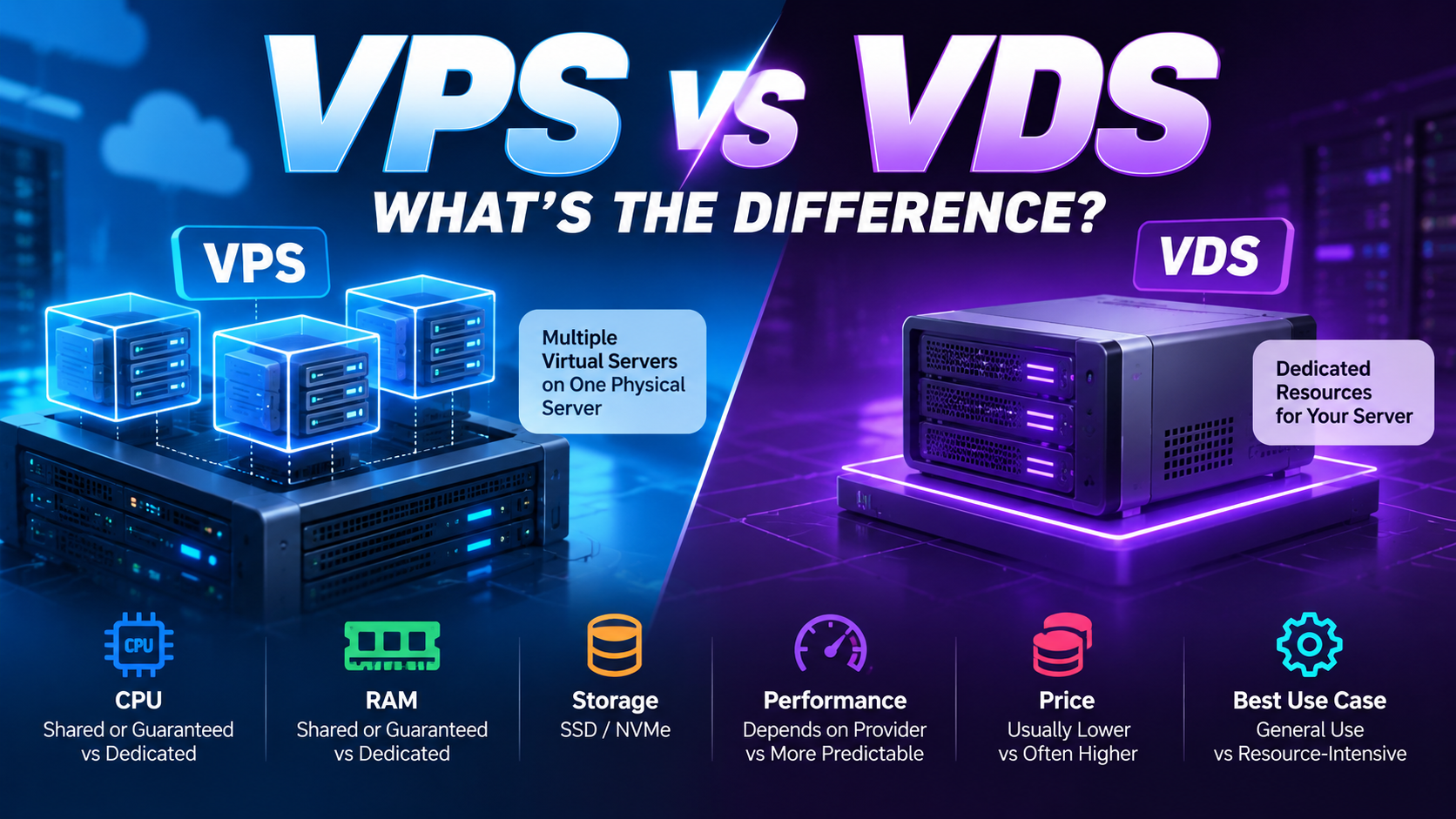
A VPS is a virtual server created on a physical server using virtualization technology.
For example, a physical server with 64 CPU cores and 256 GB RAM can be divided into multiple virtual servers. Each VPS operates independently with its own operating system, storage, IP address, and allocated resources.
VPS hosting is commonly used for:
- Websites
- WordPress
- Online stores
- Web applications
- Databases
- VPNs
- Game servers
- Development projects
What Is VDS?
VDS stands for Virtual Dedicated Server.
Like a VPS, a VDS is a virtual machine running on a physical server.
The main difference is that hosting providers often use VDS to describe a virtual server with more clearly defined or dedicated resources, particularly CPU and RAM.
For example:
VPS:
«8 vCPU + 16 GB RAM»
VDS:
«8 dedicated CPU cores + 16 GB dedicated RAM»
However, this isn't a universal rule.
Different hosting companies use the terms VPS and VDS differently.
VPS vs VDS: Main Differences
Feature| VPS| VDS
Virtual server| Yes| Yes
Root access| Usually| Usually
Own operating system| Yes| Yes
RAM| May be shared/guaranteed| Usually guaranteed
CPU| May be shared/guaranteed| Usually dedicated/guaranteed
Performance| Depends on provider| Usually more predictable
Price| Usually lower| Often higher
Best for| General workloads| Resource-intensive workloads
Is VDS Better Than VPS?
Not necessarily.
This is one of the biggest misconceptions.
A good VPS can outperform a poorly configured VDS.
What matters is the actual infrastructure behind the plan:
- CPU model
- CPU allocation
- RAM allocation
- Storage type
- NVMe performance
- Network speed
- Virtualization technology
- Resource limits
- Overselling policy
- Data center quality
So don't choose a server simply because the provider calls it a VDS.
VPS vs VDS for Websites
For most small and medium websites, a VPS is more than enough.
A VPS can handle:
- WordPress
- Business websites
- Blogs
- E-commerce websites
- Multiple websites
- Web applications
If your website consistently consumes significant CPU or RAM, a dedicated-resource VDS may provide more predictable performance.
VPS vs VDS for Game Servers
For game servers, CPU performance and network latency are particularly important.
A VPS can be perfectly suitable for smaller game servers.
For larger or CPU-intensive game servers, a VDS with guaranteed resources may be a better fit.
But again, the actual hardware matters more than the VPS/VDS label.
VPS vs VDS for Developers
Developers commonly use virtual servers for:
- Docker
- APIs
- Databases
- Development environments
- Testing
- CI/CD
- VPNs
- Self-hosted applications
Both VPS and VDS can work well.
If an application continuously uses significant CPU resources, guaranteed resources become more important.
Which Should You Choose?
Choose a VPS if:
- You want an affordable virtual server
- You're hosting websites
- You need a development server
- Your workload is moderate
- You want flexibility
Consider a VDS if:
- You need predictable performance
- Your application uses a lot of CPU
- You need guaranteed RAM
- You're running a resource-intensive database
- You're hosting demanding applications or game servers
The Question You Should Ask Your Hosting Provider
Don't only ask:
«"Is this a VPS or VDS?"»
Instead ask:
«"Are the CPU and RAM resources dedicated or shared?"»
Also ask about:
- CPU model
- Number of dedicated cores
- RAM allocation
- CPU limits
- RAM overcommitment
- NVMe/SSD storage
- Network speed
- Bandwidth limits
- Backup options
- Data center location
These details tell you much more about the server's actual performance.
VPS vs VDS: Final Answer
VPS and VDS are often very similar technologies.
The biggest difference is usually how the hosting provider defines and allocates resources.
A VPS is a great option for general hosting, websites, development, and moderate workloads.
A VDS can be useful when you need more predictable or dedicated CPU and RAM resources.
So before choosing between VPS vs VDS, look
 beyond the name and compare the actual specifications.
What do you use?
VPS or VDS?
Share your experience below. Which provider are you using, and how has the performance been?
If you're looking for a virtual server, you've probably seen two terms: VPS and VDS.
But what is the actual difference between VPS and VDS? Is VDS better than VPS? And which one should you choose?
Let's break it down in simple terms.
What Is VPS?
VPS stands for Virtual Private Server.
A VPS is a virtual server created on a physical server using virtualization technology.
For example, a physical server with 64 CPU cores and 256 GB RAM can be divided into multiple virtual servers. Each VPS operates independently with its own operating system, storage, IP address, and allocated resources.
VPS hosting is commonly used for:
- Websites
- WordPress
- Online stores
- Web applications
- Databases
- VPNs
- Game servers
- Development projects
What Is VDS?
VDS stands for Virtual Dedicated Server.
Like a VPS, a VDS is a virtual machine running on a physical server.
The main difference is that hosting providers often use VDS to describe a virtual server with more clearly defined or dedicated resources, particularly CPU and RAM.
For example:
VPS:
«8 vCPU + 16 GB RAM»
VDS:
«8 dedicated CPU cores + 16 GB dedicated RAM»
However, this isn't a universal rule.
Different hosting companies use the terms VPS and VDS differently.
VPS vs VDS: Main Differences
Feature| VPS| VDS
Virtual server| Yes| Yes
Root access| Usually| Usually
Own operating system| Yes| Yes
RAM| May be shared/guaranteed| Usually guaranteed
CPU| May be shared/guaranteed| Usually dedicated/guaranteed
Performance| Depends on provider| Usually more predictable
Price| Usually lower| Often higher
Best for| General workloads| Resource-intensive workloads
Is VDS Better Than VPS?
Not necessarily.
This is one of the biggest misconceptions.
A good VPS can outperform a poorly configured VDS.
What matters is the actual infrastructure behind the plan:
- CPU model
- CPU allocation
- RAM allocation
- Storage type
- NVMe performance
- Network speed
- Virtualization technology
- Resource limits
- Overselling policy
- Data center quality
So don't choose a server simply because the provider calls it a VDS.
VPS vs VDS for Websites
For most small and medium websites, a VPS is more than enough.
A VPS can handle:
- WordPress
- Business websites
- Blogs
- E-commerce websites
- Multiple websites
- Web applications
If your website consistently consumes significant CPU or RAM, a dedicated-resource VDS may provide more predictable performance.
VPS vs VDS for Game Servers
For game servers, CPU performance and network latency are particularly important.
A VPS can be perfectly suitable for smaller game servers.
For larger or CPU-intensive game servers, a VDS with guaranteed resources may be a better fit.
But again, the actual hardware matters more than the VPS/VDS label.
VPS vs VDS for Developers
Developers commonly use virtual servers for:
- Docker
- APIs
- Databases
- Development environments
- Testing
- CI/CD
- VPNs
- Self-hosted applications
Both VPS and VDS can work well.
If an application continuously uses significant CPU resources, guaranteed resources become more important.
Which Should You Choose?
Choose a VPS if:
- You want an affordable virtual server
- You're hosting websites
- You need a development server
- Your workload is moderate
- You want flexibility
Consider a VDS if:
- You need predictable performance
- Your application uses a lot of CPU
- You need guaranteed RAM
- You're running a resource-intensive database
- You're hosting demanding applications or game servers
The Question You Should Ask Your Hosting Provider
Don't only ask:
«"Is this a VPS or VDS?"»
Instead ask:
«"Are the CPU and RAM resources dedicated or shared?"»
Also ask about:
- CPU model
- Number of dedicated cores
- RAM allocation
- CPU limits
- RAM overcommitment
- NVMe/SSD storage
- Network speed
- Bandwidth limits
- Backup options
- Data center location
These details tell you much more about the server's actual performance.
VPS vs VDS: Final Answer
VPS and VDS are often very similar technologies.
The biggest difference is usually how the hosting provider defines and allocates resources.
A VPS is a great option for general hosting, websites, development, and moderate workloads.
A VDS can be useful when you need more predictable or dedicated CPU and RAM resources.
So before choosing between VPS vs VDS, look
What do you use?
VPS or VDS?
Share your experience below. Which provider are you using, and how has the performance been?
