
Have you ever wondered why certain posts appear repeatedly on your social media feed while other stories never reach you? Why does YouTube recommend one video after another? Why do Google search results appear in a particular order? And why can two people using the same platform have completely different online experiences?
The answer involves a combination of algorithms, artificial intelligence, user behavior, advertising, platform policies, and human decisions.
The internet may offer access to an enormous amount of information, but that does not mean we see all of it. Every day, digital platforms help determine which information becomes visible, which content receives attention, and which stories remain buried beneath millions of other posts.
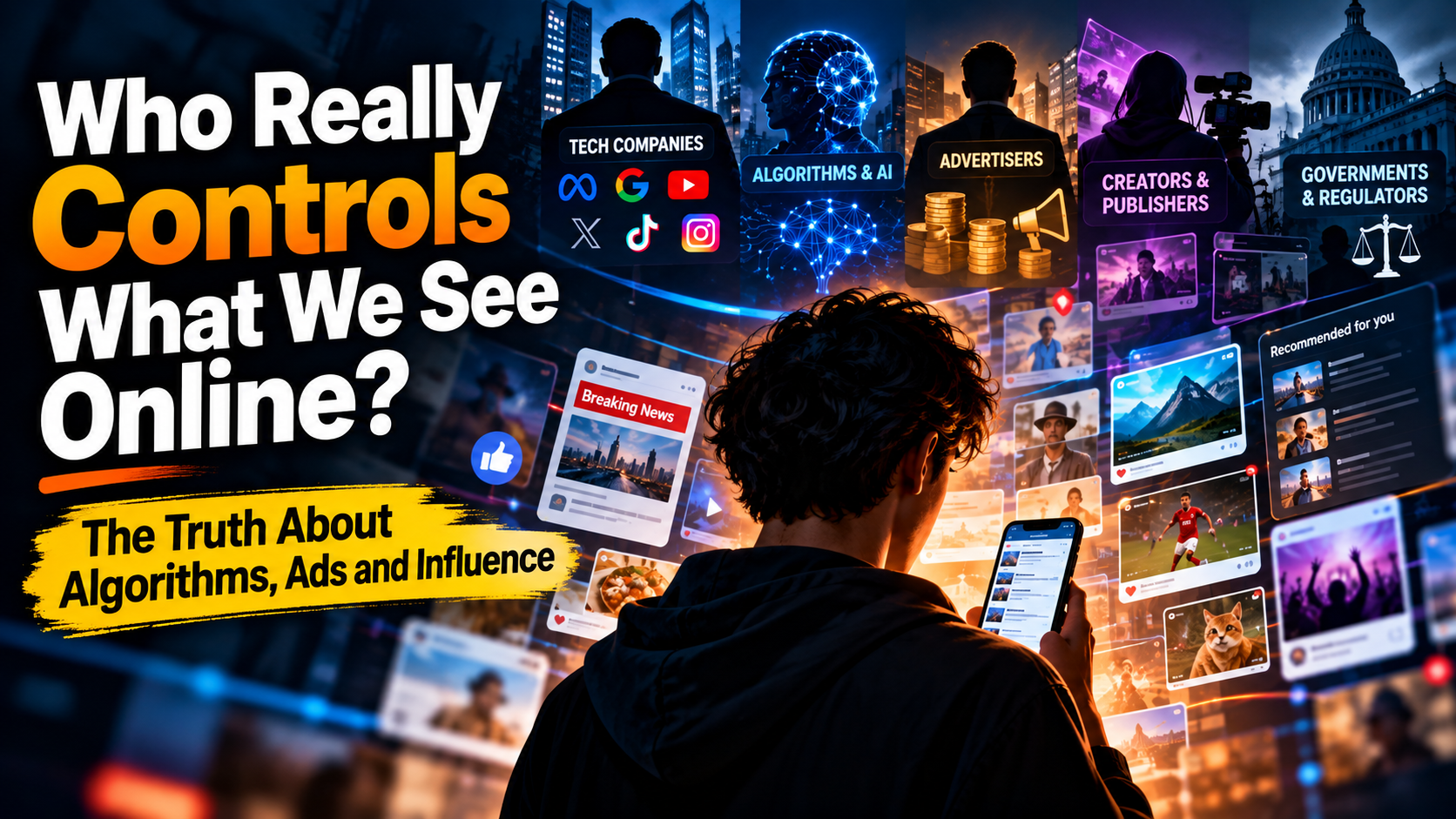
Who really controls what we see online? The answer is more complicated than simply blaming algorithms. Technology companies build the systems, advertisers compete for attention, creators produce content, governments establish rules, and users influence their own feeds through their behavior.
1. What Are Social Media Algorithms?
A social media algorithm is a set of computational rules and models used to organize, rank, recommend, or filter content on a platform.
Without some form of ranking, a popular social network could show thousands of posts in the order they were published, making it difficult to discover relevant information. Recommendation systems attempt to solve this problem by predicting which posts, videos, articles, or products may be useful or interesting to each user.
For example, when you open a social media application, its recommendation system may consider signals such as:
Accounts and people you follow.
Posts you like, comment on, share, or save.
Videos you watch and how long you watch them.
Topics you have previously explored.
Information about the content itself.
Feedback indicating that you want to see more or less of something.
The freshness of a post and other platform-specific ranking signals.
The precise signals and their importance vary by platform, product, and recommendation surface. Meta has publicly explained that its AI systems use multiple predictions to rank content on Facebook and Instagram, rather than relying on one universal measure of interest.
Source: Meta — How AI Influences What You See on Facebook and Instagram
The important distinction is that an algorithm does not simply show you everything that exists. It helps select and order the information you are most likely to encounter. That selection can make the internet easier to use, but it also gives recommendation systems considerable influence over our attention.
2. Who Controls What Appears on Your Feed?
Technology companies
Companies operating social networks and search engines design the systems that organize content on their platforms. They establish ranking objectives, develop recommendation models, set community rules, decide how advertising works, and determine what tools users have to control their experiences.
These decisions matter because changing the ranking system can change which creators, businesses, news stories, and opinions receive attention. A company might prioritize content predicted to be relevant to a user, but it must also decide how to balance relevance with freshness, safety, originality, quality, and other goals.
Artificial intelligence and recommendation systems
AI can process large amounts of information and estimate which content a person might want to see. For instance, if someone watches several videos about computer hardware, a platform may recommend server tutorials, processor comparisons, or related technology content.
However, recommendations are predictions, not proof of what a person truly wants or needs. Someone might watch a controversial video because they disagree with it. Someone else might watch a clip because it is funny, confusing, or simply difficult to ignore. The system may not always understand the reason behind the behavior.
Consequently, recommendation systems can make incorrect assumptions about people's interests and repeatedly suggest content that does not reflect their actual preferences.
Advertisers and businesses
Advertising introduces another layer of influence. Businesses pay to reach selected audiences, and platforms use advertising systems to determine which eligible advertisements are shown to which users.
Advertisers can influence which commercial messages receive exposure, but they do not necessarily control the entire organic feed or every recommendation. For example, someone searching for a laptop may see advertisements from several competing companies. Those advertisements can influence purchasing decisions, even though the person did not specifically request every brand's message.
Paid advertising can buy exposure, but it does not automatically buy complete control over what a user sees.
Content creators and publishers
Creators, journalists, influencers, and businesses also compete for visibility. They experiment with headlines, video formats, publication times, keywords, thumbnails, and storytelling techniques to attract audiences.
Some creators produce informative and original work. Others may use exaggerated claims, sensational headlines, or misleading thumbnails to encourage clicks. Platforms determine how content is distributed under their ranking and policy systems, while creators influence the material available for distribution.
Governments and regulators
Governments can affect online information through laws, court orders, content restrictions, privacy requirements, and rules governing digital platforms. The European Union's Digital Services Act, for example, includes transparency and accountability requirements for online platforms. It also provides for certain user controls over recommender systems, including a non-personalized feed option for very large online platforms and search engines.
Source: European Commission — How the Digital Services Act enhances transparency online
Government involvement can help address illegal content and protect users, but it can also raise difficult questions about freedom of expression, censorship, and political influence. The effects depend on the law, how it is implemented, and the safeguards in place.
3. How Algorithms Decide What You See
To understand the process, imagine that you open a video platform and watch several videos about artificial intelligence. The recommendation process may work roughly as follows:
Collect relevant signals. The system observes available information about your activity, the content, and the context in which recommendations are made.
Identify possible recommendations. It retrieves a set of videos that could be relevant to your interests.
Predict your response. Machine-learning models estimate the likelihood of different outcomes, such as watching, sharing, or interacting with each video.
Rank the candidates. The platform orders eligible content according to its ranking system, which may account for several objectives and constraints.
Learn from new feedback. Your subsequent activity can influence future recommendations.
This is a simplified explanation. Real systems can involve multiple ranking stages, safety filters, separate recommendation models, and objectives that vary across products.
The process can also create a feedback loop. You watch technology videos, so you receive more technology recommendations. You watch more of those recommendations, providing further evidence that the topic interests you.
Over time, your feed may become increasingly focused on technology. That can be useful if you want to learn about servers, programming, or artificial intelligence. However, it can also reduce the variety of information you encounter if the system repeatedly favors similar material.
4. Does Your Online Feed Reflect Reality?
One of the most important limitations of personalized feeds is that they are not necessarily representative of the world.
A social media feed is a selected collection of information. It reflects what the platform distributes, what people and organizations publish, what your network shares, and what the recommendation system predicts you might engage with.
Imagine that you repeatedly see posts about people becoming wealthy through cryptocurrency. You might begin to believe that this is a common or easy path to financial success. However, the posts you see may disproportionately feature successful individuals, promotional content, or exceptional stories.
You may not see an equally prominent selection of people who lost money, abandoned their projects, or never achieved the advertised results. The problem is not necessarily that every visible post is false. It is that the collection of posts may provide an incomplete picture.
The same issue can arise with technology trends, political debates, health claims, investment opportunities, and business success stories.
Visibility is not the same as representativeness, and popularity is not the same as accuracy. A topic appearing repeatedly in your feed does not establish that it is the most important issue in society. Likewise, a topic that rarely appears in your feed may still be important.
5. What Is a Filter Bubble?
A filter bubble describes a situation in which personalized information systems may limit a person's exposure to differing viewpoints or unfamiliar information.
Suppose you frequently interact with content supporting a particular opinion. A recommendation system may identify related material as relevant and show you more of it. If this pattern continues, you may encounter fewer competing arguments or alternative perspectives.
However, it is important not to overstate the evidence. Filter bubbles are a recognized concern, but their effects are not identical for every user or platform. Research does not support the claim that every personalized feed inevitably traps every user inside a completely isolated information environment.
People encounter information through many channels, including search engines, friends, professional communities, news organizations, and offline conversations. A person's choices and social environment also matter.
A more realistic concern is that personalized systems can shape the frequency, prominence, and diversity of the information people encounter.
For example, a user who follows a range of credible news sources may experience a different information environment from someone who mainly watches recommendations from a small group of creators. The solution is not necessarily to eliminate personalization. It is to make sure personalization does not become the only way we discover information.
6. Do Algorithms Promote Controversial or Misleading Content?
This question requires a careful distinction between a platform's design, its stated objectives, and the effects that researchers observe.
Content that provokes anger, fear, surprise, or strong disagreement can generate substantial interaction. In some circumstances, sensational material may therefore compete successfully for attention. If a ranking system rewards signals that correlate with continued viewing or interaction, it may sometimes favor material that attracts attention without necessarily being accurate or socially beneficial.
But that does not mean every platform always promotes controversial content, or that every recommendation algorithm is designed specifically to spread misinformation. Platforms use different objectives, safeguards, and moderation systems. Their outcomes also vary across topics, countries, languages, and periods.
Research published by Pew Research Center illustrates why this issue matters. In its June 2024 study of U.S. adults who use TikTok, X, Facebook, and Instagram, the center found that majorities of news consumers on all four platforms said they encountered news that seemed inaccurate at least sometimes. About a quarter or more on each platform said this happened extremely or fairly often.
The study also found that many news consumers believed the platforms influenced which stories they saw. Among news consumers on Facebook, 74% said the platform influenced the news stories they saw at least somewhat; the corresponding figure was 72% for Instagram, 66% for X, and 61% for TikTok.
These figures describe people's reported experiences and perceptions, not an independent measurement of the algorithms' causal effects on accuracy.
Source: Pew Research Center — How Americans Get News on TikTok, X, Facebook and Instagram
The findings nevertheless demonstrate that people encounter questionable information online and recognize that platforms play a role in selecting what becomes visible. This makes content quality, transparency, media literacy, and effective moderation important issues.
7. Are Social Media Companies Manipulating Our Opinions?
The word manipulation can mean different things, so it is useful to distinguish influence from deliberate deception.
A platform influences your information environment when it decides how content is ranked, recommended, restricted, or promoted. That influence is built into the structure of most large digital platforms. However, proving that a platform deliberately manipulates a particular person's political beliefs or opinions requires more evidence than simply observing a personalized feed.
Repeated exposure
Seeing the same claim repeatedly can make it feel familiar. Familiarity, however, does not establish truth.
Social proof
Posts with many likes, shares, or comments can appear more credible or important, even when the engagement does not reflect the quality of the information.
Selective exposure
People often choose content that aligns with their existing interests and beliefs. Recommendation systems can reinforce this tendency, although they do not create it from nothing.
Advertising and persuasion
Commercial and political advertising can present targeted messages to particular audiences. Their effects depend on the message, the audience, the context, and many other factors.
Content moderation
Platforms decide how to handle material that violates their policies or applicable laws. These decisions can affect public discussion and raise legitimate questions about consistency, transparency, and appeals.
Taken together, these mechanisms show why platform design deserves scrutiny. Yet it would be inaccurate to conclude that every recommendation is propaganda or that technology companies can completely control what people believe. Users interpret information differently, compare sources, challenge claims, and make independent decisions.
The evidence supports concern about influence, not the assumption of total control.
8. Who Controls Google Search Results?
The question extends beyond social media. Search engines also organize enormous amounts of information and rank results according to systems designed to identify useful and relevant answers.
Search ranking can consider many factors, including the relevance of a page to a query, its content, links and references from other pages, usability, freshness when appropriate, and other signals. The exact systems differ and change over time.
For example, two pages may discuss the same topic, but one might provide clearer explanations, stronger evidence, more useful information, and a better experience for readers. A search engine may rank one page above the other because it estimates that the first is more useful for a particular query.
However, ranking systems are not perfect measures of truth. A highly ranked page can contain mistakes, and a useful page may receive limited visibility. Search results can also include sponsored placements, which should be distinguished from organic results.
This is why search engine optimization, or SEO, matters to publishers and businesses: it helps them make useful content discoverable. But good SEO should support the reader rather than replace accuracy, originality, or expertise.
For users, the practical lesson is straightforward: do not assume that the first result is automatically the most reliable source. Compare sources, check publication dates, look for supporting evidence, and consult original documents when the subject is important.
9. Is the Internet Creating Different Realities for Different People?
In many ways, yes—but not because every person lives in a completely separate online world.
Two people searching for information or opening the same social network may encounter different recommendations because they follow different accounts, have different interests, use different settings, and interact with different content. They may also live in different regions or languages, where different information sources and rules apply.
Consider an example. One person follows technology researchers, software developers, and scientific publications. Another mainly follows entertainment influencers and celebrity accounts. Both may open the same social media platform, but their feeds will likely emphasize different subjects.
Now imagine that both people encounter a major public event. One may see detailed reporting from established news organizations, while the other may first encounter reaction videos, short clips, or commentary from influencers. Neither feed necessarily represents the full range of available information.
This can affect conversations between people. Each person may sincerely believe that their own feed reflects what everyone is discussing, even though their online experiences differ substantially. The result can be misunderstanding, misplaced confidence, or disagreement about which issues deserve attention.
The best response is not to assume that everyone who disagrees with us has been manipulated. It is to recognize that people can encounter different evidence and perspectives, then make a deliberate effort to compare information.
10. Can You Take Control of What You See Online?
Although platforms determine many aspects of content distribution, users are not powerless. The exact controls available vary by service, but the following practices can help you build a more balanced information environment.
Follow diverse, credible sources
For important subjects, follow multiple reputable sources rather than relying entirely on a single creator, publication, or platform. Diversity should mean more than simply collecting opposing opinions. Include sources with different expertise, geographic perspectives, and reporting approaches, while maintaining standards for evidence.
Use chronological feeds when available
Some platforms provide a following feed or another option that emphasizes recent posts from selected accounts instead of relying entirely on personalized recommendations. Chronological feeds can offer greater predictability, although they do not eliminate selection bias. Your followed accounts still determine much of what you see.
Review your recommendation settings
Look for options to reset recommendations, manage topics, reduce suggested posts, mark content as unwanted, or control personalized experiences. For example, some services allow users to select a different feed or adjust their interests. These controls can improve the relevance of recommendations, but their availability and effects differ across platforms.
Be careful with engagement
Liking, commenting on, sharing, and watching content can provide signals that a platform may use to predict your interests. If you repeatedly interact with a topic you dislike, the system may misinterpret that behavior as interest, depending on the platform. Use feedback options when available, and review the accounts and subjects you actively choose to follow.
Verify important claims
Before sharing a surprising story, check whether reputable sources independently report it. For health, financial, legal, and public-policy claims, look for relevant primary sources, official documents, peer-reviewed research, or expert analysis. A large number of likes or shares is not a substitute for evidence.
Take advantage of privacy settings
Review the privacy controls available on your accounts and devices. Depending on the service, you may be able to manage ad personalization, activity history, location access, and other data settings. These changes can reduce certain forms of data collection or personalization, but they do not guarantee complete anonymity or eliminate all recommendation signals.
The goal is not to escape every algorithm. It is to make more deliberate choices about the information you consume.
11. Should Platforms Be More Transparent About Their Algorithms?
Transparency is one possible way to improve accountability, but it has practical limitations.
When platforms explain the main factors influencing recommendations, users can better understand why particular content appears and what controls are available. Researchers can also benefit from appropriate access to information that helps them investigate systemic risks, content distribution, and possible unintended consequences.
Regulation is one approach to encouraging transparency. The European Union's Digital Services Act establishes several transparency and accountability mechanisms, including requirements concerning recommender systems and certain large platforms' systemic risks. For very large online platforms and search engines, the legislation also includes an option for users to choose a recommendation system that is not based on profiling.
Source: European Commission — How the Digital Services Act enhances transparency online
However, transparency alone does not solve every problem. Publishing technical documentation does not automatically make a system understandable to ordinary users. Revealing too much operational detail can also create security risks or allow people to game the system.
Furthermore, even a fully documented algorithm cannot eliminate disagreements about what counts as harmful content, reliable information, or a fair ranking. Effective accountability may therefore require a combination of understandable explanations, meaningful user controls, independent research, appropriate privacy protections, and mechanisms to challenge platform decisions.
The objective should be to make powerful systems more accountable without assuming that one rule or technical change can solve every problem.
12. The Future: Will AI Have Even More Influence Over What We See?
Artificial intelligence is changing how people discover information. Traditional search often begins with a question and returns a list of links. Recommendation systems present content based on predicted interests. AI assistants can go a step further by synthesizing information into direct answers, summaries, and personalized suggestions.
This creates new opportunities. AI can help users navigate complex subjects, compare explanations, translate information, and discover material that might otherwise be difficult to find.
But it also creates new challenges. When an AI system summarizes a topic, it must select which facts, sources, and interpretations to include. Important context may be omitted, and generated answers can contain errors.
If people increasingly rely on AI assistants rather than consulting original sources, the systems that choose and summarize information may become even more influential.
That does not mean AI will inevitably control what everyone believes. Outcomes will depend on how these tools are designed, how users interact with them, what sources they rely on, and what safeguards are implemented.
The ability to inspect sources, compare answers, and challenge automated conclusions will remain important. In an AI-driven internet, knowing how to evaluate information may become just as important as knowing how to find it.
Conclusion: Who Really Controls What We See Online?
So, who controls what we see online? The answer is shared, but the influence is unequal.
Technology companies build the platforms and ranking systems. AI models help predict what content may interest us. Advertisers pay for commercial exposure. Creators and publishers compete for attention. Governments establish rules, and users influence their feeds through their choices and behavior.
No single group controls every aspect of the internet. Nevertheless, the organizations that design and operate major platforms have substantial influence over how information is distributed.
The central issue is not simply whether algorithms exist. They are useful tools for organizing information at a scale that humans could not manage manually. The more important questions are how these systems are designed, what objectives they pursue, how well they handle unreliable content, what users can control, and how their decisions can be examined.
A personalized feed can help you discover useful information, but it should not become your only window into the world. Follow diverse sources. Verify important claims. Understand why recommendations appear. Explore information beyond your usual interests.
The internet gives us access to an enormous amount of information. Learning to question how that information reaches us is what helps us use it wisely.
The next time you open your feed, ask yourself one simple question: Am I choosing what I see, or is the system choosing it for me? The answer is likely to involve both.
Frequently Asked Questions (FAQs)
1. Who controls what we see on social media?
Social media companies establish the ranking systems, recommendation models, and platform policies that shape what appears in users' feeds. Advertisers, content creators, user behavior, and applicable laws also influence the information people encounter.
2. How do social media algorithms work?
Social media algorithms use available information about users, content, and context to organize and recommend posts. Many systems predict which content a person may find relevant or engaging, then rank eligible content according to platform-specific objectives and rules.
3. Do algorithms control our opinions?
Algorithms can influence which information people encounter, but that does not mean they completely determine people's opinions. Beliefs are also shaped by personal experience, education, social relationships, culture, and independent reasoning.
4. What is a filter bubble?
A filter bubble is a potential effect of personalization in which users encounter a narrower range of information or viewpoints. The extent of this effect varies, and personalized recommendations do not automatically isolate every user from opposing perspectives.
5. Why do I keep seeing similar content online?
Recommendation systems may interpret repeated viewing, likes, shares, and other activity as signals of interest. They may then recommend similar material. Following different sources and using available recommendation controls can help diversify your feed.
6. Can advertisers control my social media feed?
Advertisers can pay to distribute eligible advertisements to selected audiences under a platform's advertising rules. They do not automatically control all organic posts or recommendations, although advertising can influence which commercial messages receive visibility.
7. Is the first result on Google always the most reliable?
No. Search ranking attempts to identify useful results for a query, but a high position does not guarantee accuracy. Check the source's credibility, evidence, publication date, and supporting references.
8. How can I avoid misinformation online?
Check important claims against multiple credible sources, look for original evidence, examine publication dates, and be cautious with sensational headlines. Do not treat popularity, verification badges, or repeated exposure as proof that a claim is true.
9. Can I turn off personalized recommendations?
Some platforms offer chronological feeds, non-personalized recommendations, topic controls, or options to reset recommendation history. The available features vary by service, and turning off one form of personalization may not eliminate every type of ranking or data use.
10. Why does online algorithm transparency matter?
Transparency can help users understand why content is recommended, give researchers opportunities to examine potential risks, and make it easier to hold platforms accountable. Its effectiveness depends on whether explanations and controls are understan
 dable, meaningful, and supported by appropriate oversight.
The answer involves a combination of algorithms, artificial intelligence, user behavior, advertising, platform policies, and human decisions.
The internet may offer access to an enormous amount of information, but that does not mean we see all of it. Every day, digital platforms help determine which information becomes visible, which content receives attention, and which stories remain buried beneath millions of other posts.
Who really controls what we see online? The answer is more complicated than simply blaming algorithms. Technology companies build the systems, advertisers compete for attention, creators produce content, governments establish rules, and users influence their own feeds through their behavior.
1. What Are Social Media Algorithms?
A social media algorithm is a set of computational rules and models used to organize, rank, recommend, or filter content on a platform.
Without some form of ranking, a popular social network could show thousands of posts in the order they were published, making it difficult to discover relevant information. Recommendation systems attempt to solve this problem by predicting which posts, videos, articles, or products may be useful or interesting to each user.
For example, when you open a social media application, its recommendation system may consider signals such as:
Accounts and people you follow.
Posts you like, comment on, share, or save.
Videos you watch and how long you watch them.
Topics you have previously explored.
Information about the content itself.
Feedback indicating that you want to see more or less of something.
The freshness of a post and other platform-specific ranking signals.
The precise signals and their importance vary by platform, product, and recommendation surface. Meta has publicly explained that its AI systems use multiple predictions to rank content on Facebook and Instagram, rather than relying on one universal measure of interest.
Source: Meta — How AI Influences What You See on Facebook and Instagram
The important distinction is that an algorithm does not simply show you everything that exists. It helps select and order the information you are most likely to encounter. That selection can make the internet easier to use, but it also gives recommendation systems considerable influence over our attention.
2. Who Controls What Appears on Your Feed?
Technology companies
Companies operating social networks and search engines design the systems that organize content on their platforms. They establish ranking objectives, develop recommendation models, set community rules, decide how advertising works, and determine what tools users have to control their experiences.
These decisions matter because changing the ranking system can change which creators, businesses, news stories, and opinions receive attention. A company might prioritize content predicted to be relevant to a user, but it must also decide how to balance relevance with freshness, safety, originality, quality, and other goals.
Artificial intelligence and recommendation systems
AI can process large amounts of information and estimate which content a person might want to see. For instance, if someone watches several videos about computer hardware, a platform may recommend server tutorials, processor comparisons, or related technology content.
However, recommendations are predictions, not proof of what a person truly wants or needs. Someone might watch a controversial video because they disagree with it. Someone else might watch a clip because it is funny, confusing, or simply difficult to ignore. The system may not always understand the reason behind the behavior.
Consequently, recommendation systems can make incorrect assumptions about people's interests and repeatedly suggest content that does not reflect their actual preferences.
Advertisers and businesses
Advertising introduces another layer of influence. Businesses pay to reach selected audiences, and platforms use advertising systems to determine which eligible advertisements are shown to which users.
Advertisers can influence which commercial messages receive exposure, but they do not necessarily control the entire organic feed or every recommendation. For example, someone searching for a laptop may see advertisements from several competing companies. Those advertisements can influence purchasing decisions, even though the person did not specifically request every brand's message.
Paid advertising can buy exposure, but it does not automatically buy complete control over what a user sees.
Content creators and publishers
Creators, journalists, influencers, and businesses also compete for visibility. They experiment with headlines, video formats, publication times, keywords, thumbnails, and storytelling techniques to attract audiences.
Some creators produce informative and original work. Others may use exaggerated claims, sensational headlines, or misleading thumbnails to encourage clicks. Platforms determine how content is distributed under their ranking and policy systems, while creators influence the material available for distribution.
Governments and regulators
Governments can affect online information through laws, court orders, content restrictions, privacy requirements, and rules governing digital platforms. The European Union's Digital Services Act, for example, includes transparency and accountability requirements for online platforms. It also provides for certain user controls over recommender systems, including a non-personalized feed option for very large online platforms and search engines.
Source: European Commission — How the Digital Services Act enhances transparency online
Government involvement can help address illegal content and protect users, but it can also raise difficult questions about freedom of expression, censorship, and political influence. The effects depend on the law, how it is implemented, and the safeguards in place.
3. How Algorithms Decide What You See
To understand the process, imagine that you open a video platform and watch several videos about artificial intelligence. The recommendation process may work roughly as follows:
Collect relevant signals. The system observes available information about your activity, the content, and the context in which recommendations are made.
Identify possible recommendations. It retrieves a set of videos that could be relevant to your interests.
Predict your response. Machine-learning models estimate the likelihood of different outcomes, such as watching, sharing, or interacting with each video.
Rank the candidates. The platform orders eligible content according to its ranking system, which may account for several objectives and constraints.
Learn from new feedback. Your subsequent activity can influence future recommendations.
This is a simplified explanation. Real systems can involve multiple ranking stages, safety filters, separate recommendation models, and objectives that vary across products.
The process can also create a feedback loop. You watch technology videos, so you receive more technology recommendations. You watch more of those recommendations, providing further evidence that the topic interests you.
Over time, your feed may become increasingly focused on technology. That can be useful if you want to learn about servers, programming, or artificial intelligence. However, it can also reduce the variety of information you encounter if the system repeatedly favors similar material.
4. Does Your Online Feed Reflect Reality?
One of the most important limitations of personalized feeds is that they are not necessarily representative of the world.
A social media feed is a selected collection of information. It reflects what the platform distributes, what people and organizations publish, what your network shares, and what the recommendation system predicts you might engage with.
Imagine that you repeatedly see posts about people becoming wealthy through cryptocurrency. You might begin to believe that this is a common or easy path to financial success. However, the posts you see may disproportionately feature successful individuals, promotional content, or exceptional stories.
You may not see an equally prominent selection of people who lost money, abandoned their projects, or never achieved the advertised results. The problem is not necessarily that every visible post is false. It is that the collection of posts may provide an incomplete picture.
The same issue can arise with technology trends, political debates, health claims, investment opportunities, and business success stories.
Visibility is not the same as representativeness, and popularity is not the same as accuracy. A topic appearing repeatedly in your feed does not establish that it is the most important issue in society. Likewise, a topic that rarely appears in your feed may still be important.
5. What Is a Filter Bubble?
A filter bubble describes a situation in which personalized information systems may limit a person's exposure to differing viewpoints or unfamiliar information.
Suppose you frequently interact with content supporting a particular opinion. A recommendation system may identify related material as relevant and show you more of it. If this pattern continues, you may encounter fewer competing arguments or alternative perspectives.
However, it is important not to overstate the evidence. Filter bubbles are a recognized concern, but their effects are not identical for every user or platform. Research does not support the claim that every personalized feed inevitably traps every user inside a completely isolated information environment.
People encounter information through many channels, including search engines, friends, professional communities, news organizations, and offline conversations. A person's choices and social environment also matter.
A more realistic concern is that personalized systems can shape the frequency, prominence, and diversity of the information people encounter.
For example, a user who follows a range of credible news sources may experience a different information environment from someone who mainly watches recommendations from a small group of creators. The solution is not necessarily to eliminate personalization. It is to make sure personalization does not become the only way we discover information.
6. Do Algorithms Promote Controversial or Misleading Content?
This question requires a careful distinction between a platform's design, its stated objectives, and the effects that researchers observe.
Content that provokes anger, fear, surprise, or strong disagreement can generate substantial interaction. In some circumstances, sensational material may therefore compete successfully for attention. If a ranking system rewards signals that correlate with continued viewing or interaction, it may sometimes favor material that attracts attention without necessarily being accurate or socially beneficial.
But that does not mean every platform always promotes controversial content, or that every recommendation algorithm is designed specifically to spread misinformation. Platforms use different objectives, safeguards, and moderation systems. Their outcomes also vary across topics, countries, languages, and periods.
Research published by Pew Research Center illustrates why this issue matters. In its June 2024 study of U.S. adults who use TikTok, X, Facebook, and Instagram, the center found that majorities of news consumers on all four platforms said they encountered news that seemed inaccurate at least sometimes. About a quarter or more on each platform said this happened extremely or fairly often.
The study also found that many news consumers believed the platforms influenced which stories they saw. Among news consumers on Facebook, 74% said the platform influenced the news stories they saw at least somewhat; the corresponding figure was 72% for Instagram, 66% for X, and 61% for TikTok.
These figures describe people's reported experiences and perceptions, not an independent measurement of the algorithms' causal effects on accuracy.
Source: Pew Research Center — How Americans Get News on TikTok, X, Facebook and Instagram
The findings nevertheless demonstrate that people encounter questionable information online and recognize that platforms play a role in selecting what becomes visible. This makes content quality, transparency, media literacy, and effective moderation important issues.
7. Are Social Media Companies Manipulating Our Opinions?
The word manipulation can mean different things, so it is useful to distinguish influence from deliberate deception.
A platform influences your information environment when it decides how content is ranked, recommended, restricted, or promoted. That influence is built into the structure of most large digital platforms. However, proving that a platform deliberately manipulates a particular person's political beliefs or opinions requires more evidence than simply observing a personalized feed.
Repeated exposure
Seeing the same claim repeatedly can make it feel familiar. Familiarity, however, does not establish truth.
Social proof
Posts with many likes, shares, or comments can appear more credible or important, even when the engagement does not reflect the quality of the information.
Selective exposure
People often choose content that aligns with their existing interests and beliefs. Recommendation systems can reinforce this tendency, although they do not create it from nothing.
Advertising and persuasion
Commercial and political advertising can present targeted messages to particular audiences. Their effects depend on the message, the audience, the context, and many other factors.
Content moderation
Platforms decide how to handle material that violates their policies or applicable laws. These decisions can affect public discussion and raise legitimate questions about consistency, transparency, and appeals.
Taken together, these mechanisms show why platform design deserves scrutiny. Yet it would be inaccurate to conclude that every recommendation is propaganda or that technology companies can completely control what people believe. Users interpret information differently, compare sources, challenge claims, and make independent decisions.
The evidence supports concern about influence, not the assumption of total control.
8. Who Controls Google Search Results?
The question extends beyond social media. Search engines also organize enormous amounts of information and rank results according to systems designed to identify useful and relevant answers.
Search ranking can consider many factors, including the relevance of a page to a query, its content, links and references from other pages, usability, freshness when appropriate, and other signals. The exact systems differ and change over time.
For example, two pages may discuss the same topic, but one might provide clearer explanations, stronger evidence, more useful information, and a better experience for readers. A search engine may rank one page above the other because it estimates that the first is more useful for a particular query.
However, ranking systems are not perfect measures of truth. A highly ranked page can contain mistakes, and a useful page may receive limited visibility. Search results can also include sponsored placements, which should be distinguished from organic results.
This is why search engine optimization, or SEO, matters to publishers and businesses: it helps them make useful content discoverable. But good SEO should support the reader rather than replace accuracy, originality, or expertise.
For users, the practical lesson is straightforward: do not assume that the first result is automatically the most reliable source. Compare sources, check publication dates, look for supporting evidence, and consult original documents when the subject is important.
9. Is the Internet Creating Different Realities for Different People?
In many ways, yes—but not because every person lives in a completely separate online world.
Two people searching for information or opening the same social network may encounter different recommendations because they follow different accounts, have different interests, use different settings, and interact with different content. They may also live in different regions or languages, where different information sources and rules apply.
Consider an example. One person follows technology researchers, software developers, and scientific publications. Another mainly follows entertainment influencers and celebrity accounts. Both may open the same social media platform, but their feeds will likely emphasize different subjects.
Now imagine that both people encounter a major public event. One may see detailed reporting from established news organizations, while the other may first encounter reaction videos, short clips, or commentary from influencers. Neither feed necessarily represents the full range of available information.
This can affect conversations between people. Each person may sincerely believe that their own feed reflects what everyone is discussing, even though their online experiences differ substantially. The result can be misunderstanding, misplaced confidence, or disagreement about which issues deserve attention.
The best response is not to assume that everyone who disagrees with us has been manipulated. It is to recognize that people can encounter different evidence and perspectives, then make a deliberate effort to compare information.
10. Can You Take Control of What You See Online?
Although platforms determine many aspects of content distribution, users are not powerless. The exact controls available vary by service, but the following practices can help you build a more balanced information environment.
Follow diverse, credible sources
For important subjects, follow multiple reputable sources rather than relying entirely on a single creator, publication, or platform. Diversity should mean more than simply collecting opposing opinions. Include sources with different expertise, geographic perspectives, and reporting approaches, while maintaining standards for evidence.
Use chronological feeds when available
Some platforms provide a following feed or another option that emphasizes recent posts from selected accounts instead of relying entirely on personalized recommendations. Chronological feeds can offer greater predictability, although they do not eliminate selection bias. Your followed accounts still determine much of what you see.
Review your recommendation settings
Look for options to reset recommendations, manage topics, reduce suggested posts, mark content as unwanted, or control personalized experiences. For example, some services allow users to select a different feed or adjust their interests. These controls can improve the relevance of recommendations, but their availability and effects differ across platforms.
Be careful with engagement
Liking, commenting on, sharing, and watching content can provide signals that a platform may use to predict your interests. If you repeatedly interact with a topic you dislike, the system may misinterpret that behavior as interest, depending on the platform. Use feedback options when available, and review the accounts and subjects you actively choose to follow.
Verify important claims
Before sharing a surprising story, check whether reputable sources independently report it. For health, financial, legal, and public-policy claims, look for relevant primary sources, official documents, peer-reviewed research, or expert analysis. A large number of likes or shares is not a substitute for evidence.
Take advantage of privacy settings
Review the privacy controls available on your accounts and devices. Depending on the service, you may be able to manage ad personalization, activity history, location access, and other data settings. These changes can reduce certain forms of data collection or personalization, but they do not guarantee complete anonymity or eliminate all recommendation signals.
The goal is not to escape every algorithm. It is to make more deliberate choices about the information you consume.
11. Should Platforms Be More Transparent About Their Algorithms?
Transparency is one possible way to improve accountability, but it has practical limitations.
When platforms explain the main factors influencing recommendations, users can better understand why particular content appears and what controls are available. Researchers can also benefit from appropriate access to information that helps them investigate systemic risks, content distribution, and possible unintended consequences.
Regulation is one approach to encouraging transparency. The European Union's Digital Services Act establishes several transparency and accountability mechanisms, including requirements concerning recommender systems and certain large platforms' systemic risks. For very large online platforms and search engines, the legislation also includes an option for users to choose a recommendation system that is not based on profiling.
Source: European Commission — How the Digital Services Act enhances transparency online
However, transparency alone does not solve every problem. Publishing technical documentation does not automatically make a system understandable to ordinary users. Revealing too much operational detail can also create security risks or allow people to game the system.
Furthermore, even a fully documented algorithm cannot eliminate disagreements about what counts as harmful content, reliable information, or a fair ranking. Effective accountability may therefore require a combination of understandable explanations, meaningful user controls, independent research, appropriate privacy protections, and mechanisms to challenge platform decisions.
The objective should be to make powerful systems more accountable without assuming that one rule or technical change can solve every problem.
12. The Future: Will AI Have Even More Influence Over What We See?
Artificial intelligence is changing how people discover information. Traditional search often begins with a question and returns a list of links. Recommendation systems present content based on predicted interests. AI assistants can go a step further by synthesizing information into direct answers, summaries, and personalized suggestions.
This creates new opportunities. AI can help users navigate complex subjects, compare explanations, translate information, and discover material that might otherwise be difficult to find.
But it also creates new challenges. When an AI system summarizes a topic, it must select which facts, sources, and interpretations to include. Important context may be omitted, and generated answers can contain errors.
If people increasingly rely on AI assistants rather than consulting original sources, the systems that choose and summarize information may become even more influential.
That does not mean AI will inevitably control what everyone believes. Outcomes will depend on how these tools are designed, how users interact with them, what sources they rely on, and what safeguards are implemented.
The ability to inspect sources, compare answers, and challenge automated conclusions will remain important. In an AI-driven internet, knowing how to evaluate information may become just as important as knowing how to find it.
Conclusion: Who Really Controls What We See Online?
So, who controls what we see online? The answer is shared, but the influence is unequal.
Technology companies build the platforms and ranking systems. AI models help predict what content may interest us. Advertisers pay for commercial exposure. Creators and publishers compete for attention. Governments establish rules, and users influence their feeds through their choices and behavior.
No single group controls every aspect of the internet. Nevertheless, the organizations that design and operate major platforms have substantial influence over how information is distributed.
The central issue is not simply whether algorithms exist. They are useful tools for organizing information at a scale that humans could not manage manually. The more important questions are how these systems are designed, what objectives they pursue, how well they handle unreliable content, what users can control, and how their decisions can be examined.
A personalized feed can help you discover useful information, but it should not become your only window into the world. Follow diverse sources. Verify important claims. Understand why recommendations appear. Explore information beyond your usual interests.
The internet gives us access to an enormous amount of information. Learning to question how that information reaches us is what helps us use it wisely.
The next time you open your feed, ask yourself one simple question: Am I choosing what I see, or is the system choosing it for me? The answer is likely to involve both.
Frequently Asked Questions (FAQs)
1. Who controls what we see on social media?
Social media companies establish the ranking systems, recommendation models, and platform policies that shape what appears in users' feeds. Advertisers, content creators, user behavior, and applicable laws also influence the information people encounter.
2. How do social media algorithms work?
Social media algorithms use available information about users, content, and context to organize and recommend posts. Many systems predict which content a person may find relevant or engaging, then rank eligible content according to platform-specific objectives and rules.
3. Do algorithms control our opinions?
Algorithms can influence which information people encounter, but that does not mean they completely determine people's opinions. Beliefs are also shaped by personal experience, education, social relationships, culture, and independent reasoning.
4. What is a filter bubble?
A filter bubble is a potential effect of personalization in which users encounter a narrower range of information or viewpoints. The extent of this effect varies, and personalized recommendations do not automatically isolate every user from opposing perspectives.
5. Why do I keep seeing similar content online?
Recommendation systems may interpret repeated viewing, likes, shares, and other activity as signals of interest. They may then recommend similar material. Following different sources and using available recommendation controls can help diversify your feed.
6. Can advertisers control my social media feed?
Advertisers can pay to distribute eligible advertisements to selected audiences under a platform's advertising rules. They do not automatically control all organic posts or recommendations, although advertising can influence which commercial messages receive visibility.
7. Is the first result on Google always the most reliable?
No. Search ranking attempts to identify useful results for a query, but a high position does not guarantee accuracy. Check the source's credibility, evidence, publication date, and supporting references.
8. How can I avoid misinformation online?
Check important claims against multiple credible sources, look for original evidence, examine publication dates, and be cautious with sensational headlines. Do not treat popularity, verification badges, or repeated exposure as proof that a claim is true.
9. Can I turn off personalized recommendations?
Some platforms offer chronological feeds, non-personalized recommendations, topic controls, or options to reset recommendation history. The available features vary by service, and turning off one form of personalization may not eliminate every type of ranking or data use.
10. Why does online algorithm transparency matter?
Transparency can help users understand why content is recommended, give researchers opportunities to examine potential risks, and make it easier to hold platforms accountable. Its effectiveness depends on whether explanations and controls are understan
