
Can AI Replace Human Jobs? The Truth About the Future of Work
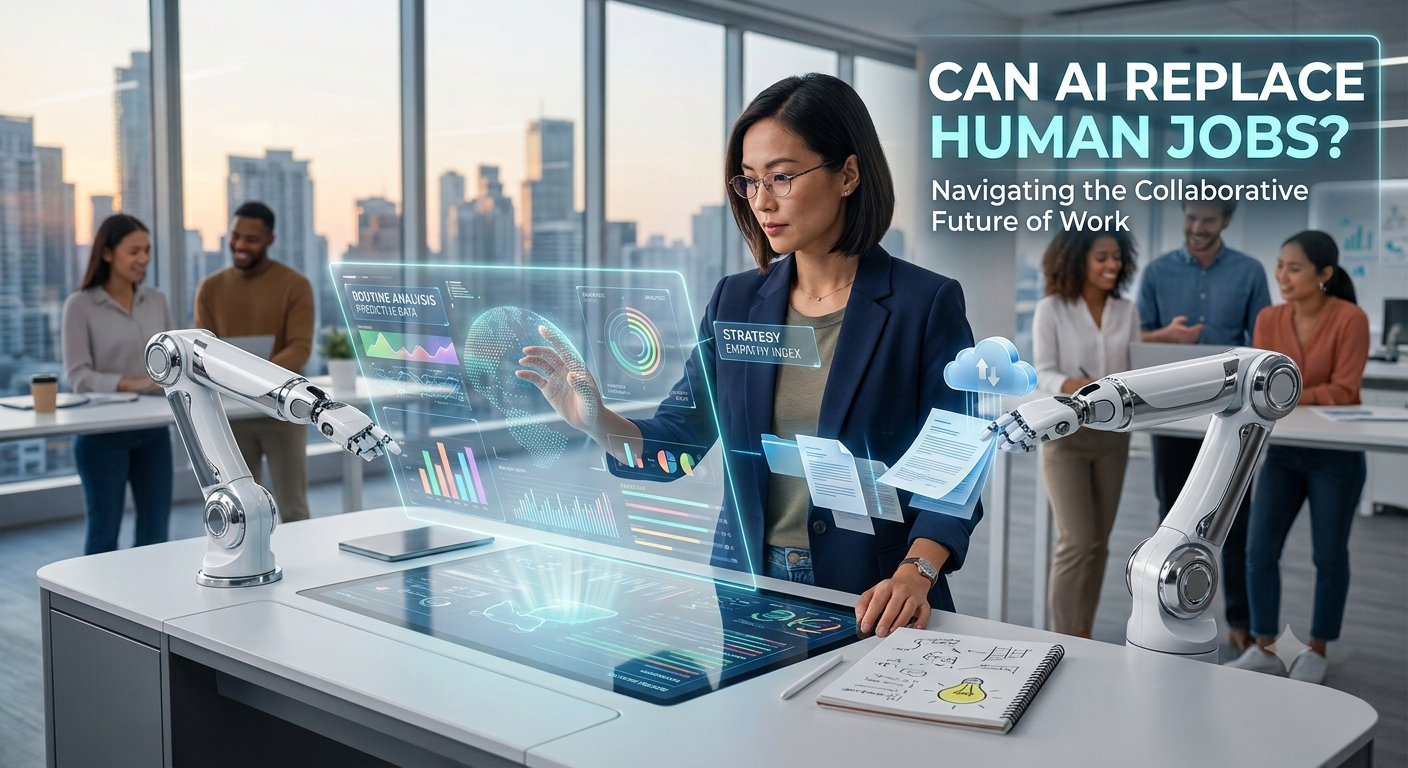
The rapid evolution of artificial intelligence has sparked a global conversation, leaving professionals across every industry asking the same pressing question: Can AI replace human jobs?
From generative AI writing code to machine learning algorithms diagnosing diseases, the capabilities of modern technology can feel overwhelming. Headlines frequently warn of a looming "jobs apocalypse," predicting mass unemployment as robots and software take over. However, when we look past the sensationalism and analyze workforce data, the reality is far more nuanced, practical, and surprisingly optimistic.
The short answer is no, AI will not completely replace humans. Instead, we are entering a transformative era of workplace collaboration where artificial intelligence handles routine tasks, making our uniquely human skills more valuable than ever before.
AI Automation vs. AI Augmentation
To understand the future of work, we have to recognize the difference between replacing a job and automating a task.
Most jobs are made up of dozens of daily tasks. AI excels at taking over the repetitive, data-heavy, and predictable components of a workday. This is known as AI augmentation. By acting as a high-powered digital assistant, AI frees up human workers from cognitive clutter.
For example, an accountant might spend hours manually sorting through spreadsheets. An AI tool can automate that data entry in seconds. Does the AI replace the accountant? No. It gives the accountant the time to focus on strategic financial planning, advising clients, and finding tax-saving opportunities—tasks that require human judgment and relationship-building.
Which Industries Will Be Most Impacted by AI?
The speed at which AI disrupts an industry depends heavily on data availability and predictability. AI models are trained on massive datasets, meaning fields with vast amounts of digital information are feeling the shift first.
* Customer Service and Administration: Chatbots and virtual assistants are already handling Tier-1 customer support, answering FAQs, and routing tickets. This allows human agents to focus on complex, emotionally sensitive customer escalations.
* Data Analysis and Finance: Algorithms can process market trends, detect fraud, and generate financial reports far faster and more accurately than a human ever could.
* Logistics and Supply Chain: AI is optimizing delivery routes in real-time and predicting inventory shortages before they happen, making the entire supply chain more efficient.
The "AI-Proof" Sectors
Conversely, industries that lack standardized data or require complex physical adaptability are highly insulated from AI replacement:
* Skilled Trades and Construction: Every plumbing issue, electrical fault, and construction site is unique. Robots currently lack the dynamic physical dexterity required to navigate these unpredictable environments.
* Healthcare and Therapy: While AI can assist in reading X-rays, the core of healthcare relies on patient trust, bedside manner, and ethical decision-making. Furthermore, strict data privacy laws prevent AI from accessing the centralized data it would need to operate autonomously.
Why Artificial Intelligence Won't Replace Humans
Despite its incredible processing power, AI has fundamental limitations. It is a prediction engine, not a sentient being. Here is why humans will remain at the center of the workforce:
* Lack of Emotional Intelligence (EQ): AI does not feel empathy. It cannot read a room, navigate the emotional nuances of team dynamics, or build genuine trust with a client. Business is fundamentally about human relationships.
* Inability to Navigate Ambiguity: AI relies on historical data to predict future outcomes. When faced with a completely unprecedented crisis or a highly ambiguous problem, AI struggles. Humans excel at thinking on their feet and drawing inspiration from unrelated fields.
* No Moral or Ethical Compass: AI cannot be held accountable. Major business decisions, legal rulings, and medical diagnoses require a human to weigh the ethical implications and take responsibility for the outcome.
The Human Skills You Need to Thrive in the AI Era
As artificial intelligence absorbs the transactional and repetitive workload, the economic value of "soft skills" is skyrocketing. To future-proof your career and remain competitive in an AI-driven job market, focus on developing these uniquely human capabilities:
* Complex Problem-Solving: The ability to look at a multifaceted issue, understand the context, and devise a strategic solution.
* Creativity and Innovation: AI can remix existing ideas, but it cannot generate truly original thought. Visionary thinking remains entirely human.
* Adaptability and Lifelong Learning: The tools we use will change rapidly. The most valuable employees will be those who can quickly learn new technologies and adapt to shifting workflows.
* Advanced Communication: Persuasion, negotiation, and storytelling are vital. You must be able to translate complex ideas into compelling narratives that inspire others to act.
Embracing the AI Revolution
History shows us that every major technological revolution—from the steam engine to the internet—has destroyed certain jobs while creating entirely new ones. The AI revolution will be no different. We are already seeing the rise of new professions, such as AI prompt engineers, ethics managers, and machine learning maintenance specialists.
The professionals who will lose out in the coming years are not those who are replaced by AI, but those who are replaced by other humans using AI.
By embracing artificial intelligence as a collaborative tool rather than a competitor, you can exponentially increase your productivity. AI is not the end of human-centric work; it is the catalyst for it. By delegating the robotic tasks to the robots, we are finally giving ourselve
s the freedom to be more human.
The rapid evolution of artificial intelligence has sparked a global conversation, leaving professionals across every industry asking the same pressing question: Can AI replace human jobs?
From generative AI writing code to machine learning algorithms diagnosing diseases, the capabilities of modern technology can feel overwhelming. Headlines frequently warn of a looming "jobs apocalypse," predicting mass unemployment as robots and software take over. However, when we look past the sensationalism and analyze workforce data, the reality is far more nuanced, practical, and surprisingly optimistic.
The short answer is no, AI will not completely replace humans. Instead, we are entering a transformative era of workplace collaboration where artificial intelligence handles routine tasks, making our uniquely human skills more valuable than ever before.
AI Automation vs. AI Augmentation
To understand the future of work, we have to recognize the difference between replacing a job and automating a task.
Most jobs are made up of dozens of daily tasks. AI excels at taking over the repetitive, data-heavy, and predictable components of a workday. This is known as AI augmentation. By acting as a high-powered digital assistant, AI frees up human workers from cognitive clutter.
For example, an accountant might spend hours manually sorting through spreadsheets. An AI tool can automate that data entry in seconds. Does the AI replace the accountant? No. It gives the accountant the time to focus on strategic financial planning, advising clients, and finding tax-saving opportunities—tasks that require human judgment and relationship-building.
Which Industries Will Be Most Impacted by AI?
The speed at which AI disrupts an industry depends heavily on data availability and predictability. AI models are trained on massive datasets, meaning fields with vast amounts of digital information are feeling the shift first.
* Customer Service and Administration: Chatbots and virtual assistants are already handling Tier-1 customer support, answering FAQs, and routing tickets. This allows human agents to focus on complex, emotionally sensitive customer escalations.
* Data Analysis and Finance: Algorithms can process market trends, detect fraud, and generate financial reports far faster and more accurately than a human ever could.
* Logistics and Supply Chain: AI is optimizing delivery routes in real-time and predicting inventory shortages before they happen, making the entire supply chain more efficient.
The "AI-Proof" Sectors
Conversely, industries that lack standardized data or require complex physical adaptability are highly insulated from AI replacement:
* Skilled Trades and Construction: Every plumbing issue, electrical fault, and construction site is unique. Robots currently lack the dynamic physical dexterity required to navigate these unpredictable environments.
* Healthcare and Therapy: While AI can assist in reading X-rays, the core of healthcare relies on patient trust, bedside manner, and ethical decision-making. Furthermore, strict data privacy laws prevent AI from accessing the centralized data it would need to operate autonomously.
Why Artificial Intelligence Won't Replace Humans
Despite its incredible processing power, AI has fundamental limitations. It is a prediction engine, not a sentient being. Here is why humans will remain at the center of the workforce:
* Lack of Emotional Intelligence (EQ): AI does not feel empathy. It cannot read a room, navigate the emotional nuances of team dynamics, or build genuine trust with a client. Business is fundamentally about human relationships.
* Inability to Navigate Ambiguity: AI relies on historical data to predict future outcomes. When faced with a completely unprecedented crisis or a highly ambiguous problem, AI struggles. Humans excel at thinking on their feet and drawing inspiration from unrelated fields.
* No Moral or Ethical Compass: AI cannot be held accountable. Major business decisions, legal rulings, and medical diagnoses require a human to weigh the ethical implications and take responsibility for the outcome.
The Human Skills You Need to Thrive in the AI Era
As artificial intelligence absorbs the transactional and repetitive workload, the economic value of "soft skills" is skyrocketing. To future-proof your career and remain competitive in an AI-driven job market, focus on developing these uniquely human capabilities:
* Complex Problem-Solving: The ability to look at a multifaceted issue, understand the context, and devise a strategic solution.
* Creativity and Innovation: AI can remix existing ideas, but it cannot generate truly original thought. Visionary thinking remains entirely human.
* Adaptability and Lifelong Learning: The tools we use will change rapidly. The most valuable employees will be those who can quickly learn new technologies and adapt to shifting workflows.
* Advanced Communication: Persuasion, negotiation, and storytelling are vital. You must be able to translate complex ideas into compelling narratives that inspire others to act.
Embracing the AI Revolution
History shows us that every major technological revolution—from the steam engine to the internet—has destroyed certain jobs while creating entirely new ones. The AI revolution will be no different. We are already seeing the rise of new professions, such as AI prompt engineers, ethics managers, and machine learning maintenance specialists.
The professionals who will lose out in the coming years are not those who are replaced by AI, but those who are replaced by other humans using AI.
By embracing artificial intelligence as a collaborative tool rather than a competitor, you can exponentially increase your productivity. AI is not the end of human-centric work; it is the catalyst for it. By delegating the robotic tasks to the robots, we are finally giving ourselve
s the freedom to be more human.
