
Artificial intelligence has rapidly transitioned from the realm of science fiction into our everyday reality. It curates our social media feeds, helps doctors diagnose diseases, and even powers the customer service chatbots we interact with daily. Yet, despite its widespread integration, AI remains one of the most misunderstood technologies of our time.
Pop culture, alarming headlines, and a general fear of the unknown have given rise to persistent myths that can hinder innovation and cause unnecessary panic. To harness the true potential of AI, we must separate Hollywood fiction from technological fact.
Myth 1: AI is self-aware and conscious
When people think of AI, images of The Terminator or HAL 9000 often spring to mind—sentient machines that possess thoughts, feelings, and hidden agendas.
The Fact: AI does not think, feel, or possess consciousness.
Current AI systems—including advanced Large Language Models (LLMs) like ChatGPT or Gemini—are incredibly sophisticated probabilistic calculators. They excel at pattern recognition, analyzing massive datasets to predict the most logical next word in a sentence or the most likely outcome of a scenario. When an AI generates a response that sounds empathetic or thoughtful, it is simply mimicking human communication based on the data it was trained on, not experiencing genuine emotion or understanding.
Myth 2: AI is coming for your job
The fear of mass unemployment due to automation is perhaps the most pervasive anxiety surrounding AI.
The Fact: AI is a collaborator, not a wholesale replacement.
While it is true that AI will automate routine, repetitive, and data-heavy tasks, history shows that disruptive technologies tend to evolve the job market rather than destroy it. AI is designed to relieve workers from monotonous data entry or baseline analysis, freeing them up to focus on high-level strategy, creative problem-solving, and tasks requiring emotional intelligence. This concept is often called Augmented Intelligence—humans and machines working together to achieve results neither could accomplish alone.
Myth 3: AI is 100% objective and unbiased
Because computers rely on math and code, many assume that AI systems are inherently fair, neutral, and free from the prejudices that plague human decision-making.
The Fact: AI can inherit and even amplify human biases.
An AI model is only as good as the data used to train it. If a system is trained on historical data that contains societal biases, prejudices, or inequalities, the AI will learn and replicate those patterns. For example, if a recruitment AI is trained on a decade of hiring data from a male-dominated industry, it may incorrectly deduce that male candidates are inherently more qualified. Ensuring AI fairness requires constant human oversight, diverse training data, and rigorous testing.
Myth 4: AI always provides the correct answer
There is a temptation to treat AI as an omniscient oracle that holds the absolute truth to any question posed.
The Fact: AI can be confidently wrong.
Because AI systems generate responses based on probabilities and patterns rather than actual comprehension, they can suffer from "hallucinations"—instances where the model invents facts, citations, or logical leaps that sound completely plausible but are entirely fabricated. AI relies on the quality of its inputs and does not possess the human ability to intuitively sense when something "feels off." Human fact-checking remains a critical part of the process.
Myth 5: AI will destroy human creativity
With the rise of generative AI capable of writing poetry, composing music, and generating award-winning artwork, some fear that human creativity is becoming obsolete.
The Fact: AI lacks original thought and emotional depth.
Generative AI is a powerful tool for brainstorming, drafting, and overcoming writer's block. However, its creations are derivative by nature—they are remixes of existing human work. True creativity stems from lived experience, emotional nuance, cultural context, and the desire to challenge the status quo. AI can generate a technically proficient painting in the style of Van Gogh, but it cannot experience the human anguish and passion that drove Van Gogh to paint it.
The Bottom Line
AI is not a magic wand, nor is it an apocalyptic threat. It is a highly capable, evolving tool that requires human direction, ethical boundaries, and critical oversight. By discarding the myths and embracing the reality of what AI can and cannot do, we can transition from a mindset of fear to one of informed empowerment.
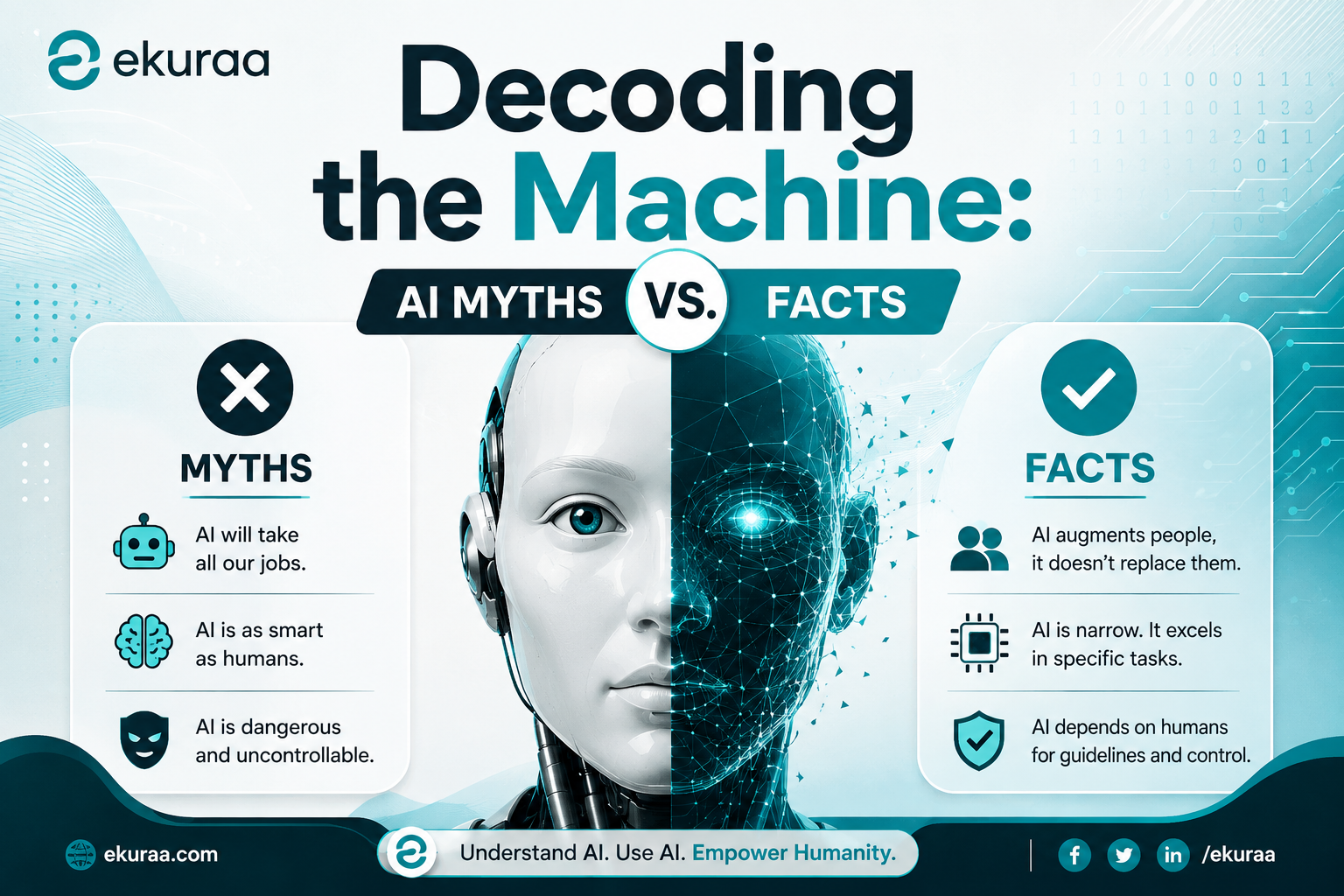
Pop culture, alarming headlines, and a general fear of the unknown have given rise to persistent myths that can hinder innovation and cause unnecessary panic. To harness the true potential of AI, we must separate Hollywood fiction from technological fact.
Myth 1: AI is self-aware and conscious
When people think of AI, images of The Terminator or HAL 9000 often spring to mind—sentient machines that possess thoughts, feelings, and hidden agendas.
The Fact: AI does not think, feel, or possess consciousness.
Current AI systems—including advanced Large Language Models (LLMs) like ChatGPT or Gemini—are incredibly sophisticated probabilistic calculators. They excel at pattern recognition, analyzing massive datasets to predict the most logical next word in a sentence or the most likely outcome of a scenario. When an AI generates a response that sounds empathetic or thoughtful, it is simply mimicking human communication based on the data it was trained on, not experiencing genuine emotion or understanding.
Myth 2: AI is coming for your job
The fear of mass unemployment due to automation is perhaps the most pervasive anxiety surrounding AI.
The Fact: AI is a collaborator, not a wholesale replacement.
While it is true that AI will automate routine, repetitive, and data-heavy tasks, history shows that disruptive technologies tend to evolve the job market rather than destroy it. AI is designed to relieve workers from monotonous data entry or baseline analysis, freeing them up to focus on high-level strategy, creative problem-solving, and tasks requiring emotional intelligence. This concept is often called Augmented Intelligence—humans and machines working together to achieve results neither could accomplish alone.
Myth 3: AI is 100% objective and unbiased
Because computers rely on math and code, many assume that AI systems are inherently fair, neutral, and free from the prejudices that plague human decision-making.
The Fact: AI can inherit and even amplify human biases.
An AI model is only as good as the data used to train it. If a system is trained on historical data that contains societal biases, prejudices, or inequalities, the AI will learn and replicate those patterns. For example, if a recruitment AI is trained on a decade of hiring data from a male-dominated industry, it may incorrectly deduce that male candidates are inherently more qualified. Ensuring AI fairness requires constant human oversight, diverse training data, and rigorous testing.
Myth 4: AI always provides the correct answer
There is a temptation to treat AI as an omniscient oracle that holds the absolute truth to any question posed.
The Fact: AI can be confidently wrong.
Because AI systems generate responses based on probabilities and patterns rather than actual comprehension, they can suffer from "hallucinations"—instances where the model invents facts, citations, or logical leaps that sound completely plausible but are entirely fabricated. AI relies on the quality of its inputs and does not possess the human ability to intuitively sense when something "feels off." Human fact-checking remains a critical part of the process.
Myth 5: AI will destroy human creativity
With the rise of generative AI capable of writing poetry, composing music, and generating award-winning artwork, some fear that human creativity is becoming obsolete.
The Fact: AI lacks original thought and emotional depth.
Generative AI is a powerful tool for brainstorming, drafting, and overcoming writer's block. However, its creations are derivative by nature—they are remixes of existing human work. True creativity stems from lived experience, emotional nuance, cultural context, and the desire to challenge the status quo. AI can generate a technically proficient painting in the style of Van Gogh, but it cannot experience the human anguish and passion that drove Van Gogh to paint it.
The Bottom Line
AI is not a magic wand, nor is it an apocalyptic threat. It is a highly capable, evolving tool that requires human direction, ethical boundaries, and critical oversight. By discarding the myths and embracing the reality of what AI can and cannot do, we can transition from a mindset of fear to one of informed empowerment.
