
What Is Reseller Hosting? A Complete Guide to Starting Your Own Hosting Business
Have you ever wanted to start a web hosting business without purchasing expensive servers or building your own data center? Reseller hosting makes this possible.
With reseller hosting, you purchase hosting resources from an established provider and sell them to your own customers under your business name. You can create hosting packages, set your own prices, and build a business serving website owners, developers, and small businesses.
Whether you are a web designer, freelancer, digital agency, or aspiring entrepreneur, reseller hosting can be a practical way to enter the web hosting industry.
In this guide, we explain what reseller hosting is, how it works, its benefits and limitations, and how to start a reseller hosting business.
What Is Reseller Hosting?
Reseller hosting is a web hosting service that allows you to purchase hosting resources from a hosting provider and resell them to individual customers.
Instead of managing your own physical servers, you use the infrastructure provided by another company. You can divide your allocated resources into smaller hosting packages based on your customers' needs.
For example, you could purchase a reseller hosting plan with 100 GB of storage and use it to create multiple hosting accounts for customers running business websites, blogs, or WordPress sites.
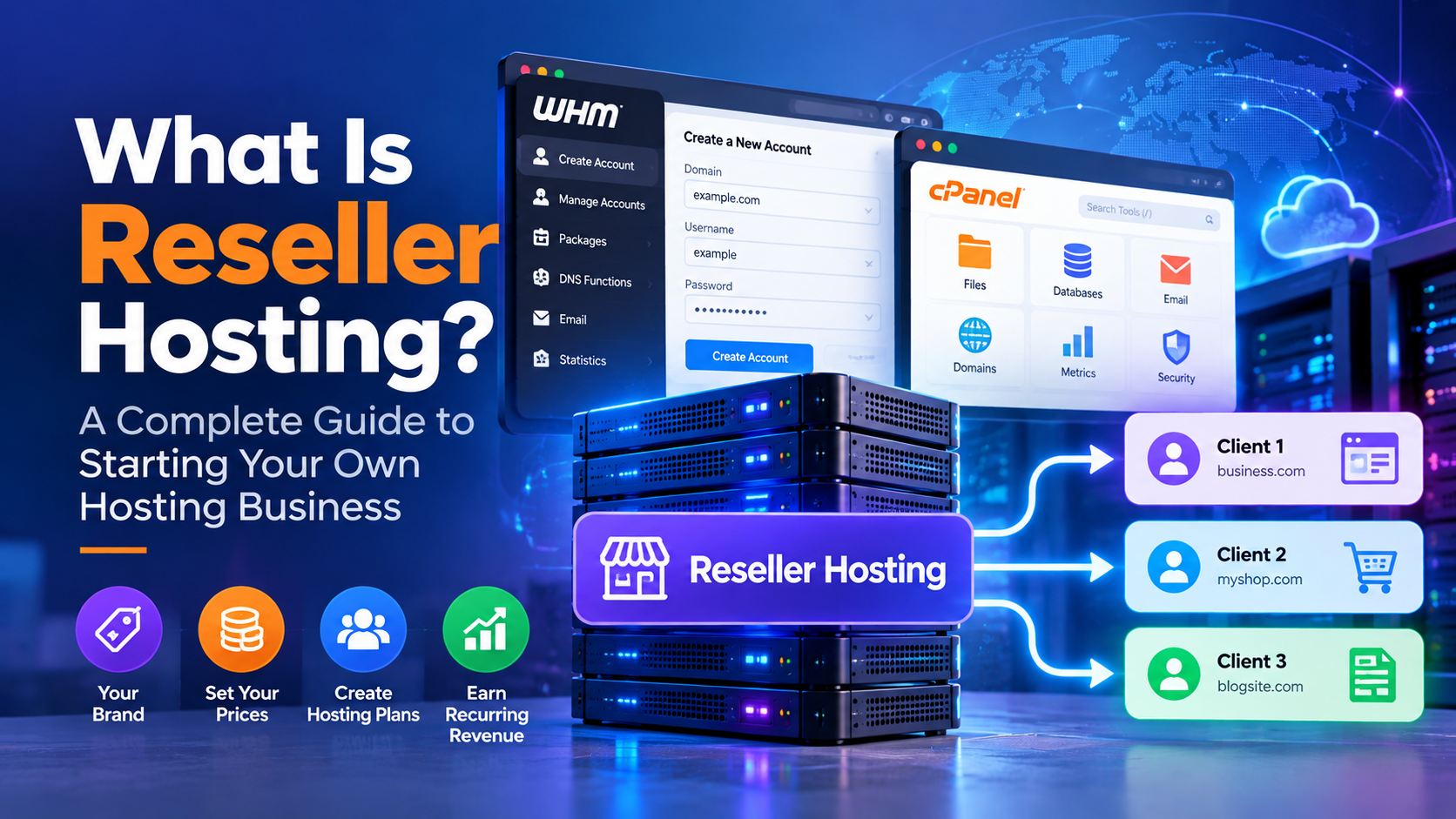
With cPanel reseller hosting, you typically use Web Host Manager (WHM) to manage customer accounts, while each customer uses cPanel to manage their own website, email, databases, and files.
This model allows you to establish your own hosting brand without immediately investing in dedicated server hardware.
How Does Reseller Hosting Work?
Reseller hosting follows a straightforward process:
1. Choose a hosting provider: Purchase a reseller plan with suitable storage, bandwidth, account limits, and features.
2. Create your hosting packages: Decide how much storage and other resources each customer receives.
3. Build your brand: Create a website, choose your pricing, and configure your hosting packages.
4. Acquire customers: Market your services to businesses, developers, bloggers, and website owners.
5. Manage customer accounts: Use your hosting control panel to create accounts and manage available resources.
6. Earn recurring revenue: Customers pay you for their hosting subscriptions, subject to your pricing and operating costs.
The upstream provider manages the underlying server infrastructure according to your service agreement. You remain responsible for your own business operations, customer communication, and the support included in your plans.
What Is White-Label Reseller Hosting?
White-label reseller hosting allows you to sell hosting services under your own brand rather than prominently displaying the infrastructure provider's brand.
Depending on the provider, white-label features may include:
- Custom branding and company identity
- Private nameservers using your domain
- Branded hosting packages and client portals
- Your own pricing and billing system
- Separate customer hosting accounts
For example, you could operate a hosting company called ExampleHost while another company supplies the underlying hosting infrastructure.
Your customers purchase hosting from your business, and you manage their relationship with them.
However, white-labeling does not mean you own the servers or control every technical component. The exact branding options depend on the provider and control panel.
Types of Reseller Hosting
Different reseller hosting solutions suit different business models.
1. cPanel Reseller Hosting
cPanel reseller hosting uses cPanel and WHM to manage hosting accounts. WHM provides reseller account management, while cPanel gives individual website owners a user-friendly control panel.
It is a popular choice for agencies, freelancers, and businesses serving customers who prefer cPanel.
2. DirectAdmin Reseller Hosting
DirectAdmin reseller hosting uses the DirectAdmin control panel to manage hosting accounts and packages.
It can be an option for businesses seeking an alternative to cPanel. Compare licensing costs, features, automation compatibility, and customer preferences before choosing a platform.
3. WordPress Reseller Hosting
Some providers offer reseller arrangements specifically designed for WordPress websites.
These services may include WordPress installation, staging tools, backups, caching, or managed maintenance. The exact features vary by provider.
4. VPS and Cloud Reselling
More technically experienced businesses can resell virtual private servers or cloud resources.
This model may offer greater flexibility than traditional shared hosting reselling, but it can require additional technical knowledge, infrastructure management, security planning, and customer support.
Benefits of Reseller Hosting
Low initial investment
You can start selling hosting without purchasing physical servers or renting an entire rack in a data center.
Your initial expenses may include the reseller plan, website, billing software, domain registration, and marketing.
Recurring revenue
Hosting is commonly sold through monthly or annual subscriptions. This creates the opportunity to build recurring revenue as your customer base grows.
However, revenue is not the same as profit. You must account for hosting fees, licenses, payment processing, support, taxes, and customer acquisition costs.
Your own business identity
White-label hosting allows you to develop your own brand, set prices, and build relationships with customers.
You can position your company around affordability, customer support, WordPress expertise, or services tailored to a specific industry.
Easy service expansion
You can combine hosting with related services such as domain registration, SSL certificates, website design, WordPress maintenance, business email, and website migration.
Offering complementary services can increase the value of each customer relationship.
No need to manage physical hardware
Your provider generally handles physical servers, power, cooling, and underlying infrastructure maintenance.
This reduces the technical and financial barriers to starting a hosting business, although it does not eliminate your responsibility for customer-facing support.
How Much Can You Earn From Reseller Hosting?
Your potential earnings depend on your hosting costs, pricing, customer numbers, operating expenses, and ability to retain customers.
Consider this simplified example.
Item| Monthly amount
Reseller hosting cost| $30
20 customers paying $5 each| $100
Revenue after hosting cost| $70
In this example, the $70 remaining is not net profit. It excludes billing software, payment fees, support, marketing, taxes, and other expenses.
As your customer base grows, revenue may increase, but you may also need additional hosting resources or licenses.
The most sustainable approach is to calculate your actual cost per customer, price your packages appropriately, and maintain enough margin to provide reliable service.
How to Start a Reseller Hosting Business
Starting a hosting business is easier when you follow a structured plan.
Step 1: Identify your target customers
Decide who you want to serve. Your audience could include small businesses, web developers, freelancers, bloggers, or local organizations.
A focused audience can make your marketing and service design more effective.
Step 2: Choose a reliable reseller hosting provider
Compare providers based on server performance, support quality, resource limits, backup policies, security features, account limits, and renewal pricing.
Do not choose a provider based on price alone. Poor performance or unreliable support can damage your reputation.
Step 3: Select your control panel
Choose cPanel or DirectAdmin based on your budget, customers' preferences, available integrations, and licensing arrangements.
Confirm which features are included in the plan and whether additional licenses are required.
Step 4: Create hosting packages
Design clear packages for different customer requirements.
For example, you could offer a basic package for small websites, a business package for growing websites, and a larger package for customers who need additional resources.
Specify the actual storage limits, account limits, backup arrangements, and support terms. Avoid advertising unlimited resources unless the provider's terms genuinely support the claim.
Step 5: Set up billing and automation
A billing platform such as WHMCS can help automate orders, invoices, recurring payments, and account provisioning when configured with compatible hosting integrations.
Automation reduces repetitive work, but you should still test account creation, renewals, cancellations, and failed-payment workflows.
Step 6: Launch your website and market your services
Publish clear pricing, service descriptions, support policies, and contact information.
Use educational content, search engine optimization, referrals, and partnerships with web designers to reach potential customers.
Step 7: Provide dependable support
Customers expect help when websites experience errors, email stops working, or domains and DNS records are misconfigured.
Establish a clear support process and understand when an issue needs to be escalated to your upstream provider.
How to Choose the Best Reseller Hosting Provider
Before purchasing a reseller hosting plan, evaluate the following factors:
- Performance: Check CPU allocation, memory limits, storage technology, and server capacity policies.
- Reliability: Review uptime commitments, incident handling, and infrastructure redundancy.
- Security: Look for appropriate account isolation, malware protection, security updates, and access controls.
- Backups: Understand backup frequency, retention, restoration procedures, and any additional fees.
- Scalability: Check how easily you can increase storage, accounts, or other resources.
- Support: Confirm the provider's support hours, response commitments, and escalation process.
- Licensing: Understand control panel and other software licensing costs.
- Migration: Ask whether account migrations are available and whether fees apply.
- Terms and restrictions: Review resource policies, acceptable-use rules, and cancellation conditions.
A reliable provider is a business partner, not just a place to purchase server space.
Reseller Hosting vs. Shared Hosting
Shared hosting is designed for customers who want to host their own websites. Reseller hosting is designed for people or businesses that want to sell hosting to multiple customers.
With a standard shared hosting account, you typically manage your own website or several websites within the permissions of that account.
With reseller hosting, you generally receive reseller management tools that allow you to create and manage separate customer accounts within your allocated limits.
Reseller hosting is therefore more appropriate when your goal is to operate a hosting business rather than simply host your own websites.
Is Reseller Hosting Worth It?
Reseller hosting can be worthwhile if you have a clear target market, competitive pricing, dependable infrastructure, and a plan for customer support.
It is particularly attractive for web designers and digital agencies that already build websites and want to provide ongoing hosting and maintenance services.
However, competition is strong, and customers can compare prices across many providers. Selling inexpensive hosting without differentiating your service can make profitability difficult.
The strongest business model often combines hosting with services customers value, such as website maintenance, migrations, security assistance, and personalized support.
Frequently Asked Questions About Reseller Hosting
Is reseller hosting profitable?
It can be profitable, but results depend on pricing, customer retention, hosting costs, support expenses, and competition. There is no guaranteed profit.
Do I need technical knowledge to start?
Basic knowledge of domains, DNS, hosting control panels, email, and website troubleshooting is useful. You can outsource some technical work, but you still need a process for helping customers.
Can I sell hosting under my own brand?
Yes, if your provider supports the required white-label features. Branding options vary between services.
Can I use reseller hosting for multiple clients?
Yes. The purpose of reseller hosting is to create and manage multiple customer hosting accounts within the limits and permissions of your plan.
Is reseller hosting better than a VPS?
Neither is universally better. Reseller hosting is generally easier for selling traditional website hosting, while a VPS offers greater system-level control when you have the expertise to manage it.
Conclusion
Reseller hosting provides a practical entry point into the web hosting industry. It allows entrepreneurs, developers, and agencies to sell hosting s
 ervices without immediately investing in their own physical server infrastructure.
By choosing a suitable provider, developing clear hosting packages, automating billing, and delivering reliable support, you can build a hosting business around recurring customer relationships.
The key is to focus on service quality and sustainable pricing rather than competing on price alone.
Follow Ekuraa for more informative guides on web hosting, cloud computing, domain names, and online business technology.
Have you ever wanted to start a web hosting business without purchasing expensive servers or building your own data center? Reseller hosting makes this possible.
With reseller hosting, you purchase hosting resources from an established provider and sell them to your own customers under your business name. You can create hosting packages, set your own prices, and build a business serving website owners, developers, and small businesses.
Whether you are a web designer, freelancer, digital agency, or aspiring entrepreneur, reseller hosting can be a practical way to enter the web hosting industry.
In this guide, we explain what reseller hosting is, how it works, its benefits and limitations, and how to start a reseller hosting business.
What Is Reseller Hosting?
Reseller hosting is a web hosting service that allows you to purchase hosting resources from a hosting provider and resell them to individual customers.
Instead of managing your own physical servers, you use the infrastructure provided by another company. You can divide your allocated resources into smaller hosting packages based on your customers' needs.
For example, you could purchase a reseller hosting plan with 100 GB of storage and use it to create multiple hosting accounts for customers running business websites, blogs, or WordPress sites.
With cPanel reseller hosting, you typically use Web Host Manager (WHM) to manage customer accounts, while each customer uses cPanel to manage their own website, email, databases, and files.
This model allows you to establish your own hosting brand without immediately investing in dedicated server hardware.
How Does Reseller Hosting Work?
Reseller hosting follows a straightforward process:
1. Choose a hosting provider: Purchase a reseller plan with suitable storage, bandwidth, account limits, and features.
2. Create your hosting packages: Decide how much storage and other resources each customer receives.
3. Build your brand: Create a website, choose your pricing, and configure your hosting packages.
4. Acquire customers: Market your services to businesses, developers, bloggers, and website owners.
5. Manage customer accounts: Use your hosting control panel to create accounts and manage available resources.
6. Earn recurring revenue: Customers pay you for their hosting subscriptions, subject to your pricing and operating costs.
The upstream provider manages the underlying server infrastructure according to your service agreement. You remain responsible for your own business operations, customer communication, and the support included in your plans.
What Is White-Label Reseller Hosting?
White-label reseller hosting allows you to sell hosting services under your own brand rather than prominently displaying the infrastructure provider's brand.
Depending on the provider, white-label features may include:
- Custom branding and company identity
- Private nameservers using your domain
- Branded hosting packages and client portals
- Your own pricing and billing system
- Separate customer hosting accounts
For example, you could operate a hosting company called ExampleHost while another company supplies the underlying hosting infrastructure.
Your customers purchase hosting from your business, and you manage their relationship with them.
However, white-labeling does not mean you own the servers or control every technical component. The exact branding options depend on the provider and control panel.
Types of Reseller Hosting
Different reseller hosting solutions suit different business models.
1. cPanel Reseller Hosting
cPanel reseller hosting uses cPanel and WHM to manage hosting accounts. WHM provides reseller account management, while cPanel gives individual website owners a user-friendly control panel.
It is a popular choice for agencies, freelancers, and businesses serving customers who prefer cPanel.
2. DirectAdmin Reseller Hosting
DirectAdmin reseller hosting uses the DirectAdmin control panel to manage hosting accounts and packages.
It can be an option for businesses seeking an alternative to cPanel. Compare licensing costs, features, automation compatibility, and customer preferences before choosing a platform.
3. WordPress Reseller Hosting
Some providers offer reseller arrangements specifically designed for WordPress websites.
These services may include WordPress installation, staging tools, backups, caching, or managed maintenance. The exact features vary by provider.
4. VPS and Cloud Reselling
More technically experienced businesses can resell virtual private servers or cloud resources.
This model may offer greater flexibility than traditional shared hosting reselling, but it can require additional technical knowledge, infrastructure management, security planning, and customer support.
Benefits of Reseller Hosting
Low initial investment
You can start selling hosting without purchasing physical servers or renting an entire rack in a data center.
Your initial expenses may include the reseller plan, website, billing software, domain registration, and marketing.
Recurring revenue
Hosting is commonly sold through monthly or annual subscriptions. This creates the opportunity to build recurring revenue as your customer base grows.
However, revenue is not the same as profit. You must account for hosting fees, licenses, payment processing, support, taxes, and customer acquisition costs.
Your own business identity
White-label hosting allows you to develop your own brand, set prices, and build relationships with customers.
You can position your company around affordability, customer support, WordPress expertise, or services tailored to a specific industry.
Easy service expansion
You can combine hosting with related services such as domain registration, SSL certificates, website design, WordPress maintenance, business email, and website migration.
Offering complementary services can increase the value of each customer relationship.
No need to manage physical hardware
Your provider generally handles physical servers, power, cooling, and underlying infrastructure maintenance.
This reduces the technical and financial barriers to starting a hosting business, although it does not eliminate your responsibility for customer-facing support.
How Much Can You Earn From Reseller Hosting?
Your potential earnings depend on your hosting costs, pricing, customer numbers, operating expenses, and ability to retain customers.
Consider this simplified example.
Item| Monthly amount
Reseller hosting cost| $30
20 customers paying $5 each| $100
Revenue after hosting cost| $70
In this example, the $70 remaining is not net profit. It excludes billing software, payment fees, support, marketing, taxes, and other expenses.
As your customer base grows, revenue may increase, but you may also need additional hosting resources or licenses.
The most sustainable approach is to calculate your actual cost per customer, price your packages appropriately, and maintain enough margin to provide reliable service.
How to Start a Reseller Hosting Business
Starting a hosting business is easier when you follow a structured plan.
Step 1: Identify your target customers
Decide who you want to serve. Your audience could include small businesses, web developers, freelancers, bloggers, or local organizations.
A focused audience can make your marketing and service design more effective.
Step 2: Choose a reliable reseller hosting provider
Compare providers based on server performance, support quality, resource limits, backup policies, security features, account limits, and renewal pricing.
Do not choose a provider based on price alone. Poor performance or unreliable support can damage your reputation.
Step 3: Select your control panel
Choose cPanel or DirectAdmin based on your budget, customers' preferences, available integrations, and licensing arrangements.
Confirm which features are included in the plan and whether additional licenses are required.
Step 4: Create hosting packages
Design clear packages for different customer requirements.
For example, you could offer a basic package for small websites, a business package for growing websites, and a larger package for customers who need additional resources.
Specify the actual storage limits, account limits, backup arrangements, and support terms. Avoid advertising unlimited resources unless the provider's terms genuinely support the claim.
Step 5: Set up billing and automation
A billing platform such as WHMCS can help automate orders, invoices, recurring payments, and account provisioning when configured with compatible hosting integrations.
Automation reduces repetitive work, but you should still test account creation, renewals, cancellations, and failed-payment workflows.
Step 6: Launch your website and market your services
Publish clear pricing, service descriptions, support policies, and contact information.
Use educational content, search engine optimization, referrals, and partnerships with web designers to reach potential customers.
Step 7: Provide dependable support
Customers expect help when websites experience errors, email stops working, or domains and DNS records are misconfigured.
Establish a clear support process and understand when an issue needs to be escalated to your upstream provider.
How to Choose the Best Reseller Hosting Provider
Before purchasing a reseller hosting plan, evaluate the following factors:
- Performance: Check CPU allocation, memory limits, storage technology, and server capacity policies.
- Reliability: Review uptime commitments, incident handling, and infrastructure redundancy.
- Security: Look for appropriate account isolation, malware protection, security updates, and access controls.
- Backups: Understand backup frequency, retention, restoration procedures, and any additional fees.
- Scalability: Check how easily you can increase storage, accounts, or other resources.
- Support: Confirm the provider's support hours, response commitments, and escalation process.
- Licensing: Understand control panel and other software licensing costs.
- Migration: Ask whether account migrations are available and whether fees apply.
- Terms and restrictions: Review resource policies, acceptable-use rules, and cancellation conditions.
A reliable provider is a business partner, not just a place to purchase server space.
Reseller Hosting vs. Shared Hosting
Shared hosting is designed for customers who want to host their own websites. Reseller hosting is designed for people or businesses that want to sell hosting to multiple customers.
With a standard shared hosting account, you typically manage your own website or several websites within the permissions of that account.
With reseller hosting, you generally receive reseller management tools that allow you to create and manage separate customer accounts within your allocated limits.
Reseller hosting is therefore more appropriate when your goal is to operate a hosting business rather than simply host your own websites.
Is Reseller Hosting Worth It?
Reseller hosting can be worthwhile if you have a clear target market, competitive pricing, dependable infrastructure, and a plan for customer support.
It is particularly attractive for web designers and digital agencies that already build websites and want to provide ongoing hosting and maintenance services.
However, competition is strong, and customers can compare prices across many providers. Selling inexpensive hosting without differentiating your service can make profitability difficult.
The strongest business model often combines hosting with services customers value, such as website maintenance, migrations, security assistance, and personalized support.
Frequently Asked Questions About Reseller Hosting
Is reseller hosting profitable?
It can be profitable, but results depend on pricing, customer retention, hosting costs, support expenses, and competition. There is no guaranteed profit.
Do I need technical knowledge to start?
Basic knowledge of domains, DNS, hosting control panels, email, and website troubleshooting is useful. You can outsource some technical work, but you still need a process for helping customers.
Can I sell hosting under my own brand?
Yes, if your provider supports the required white-label features. Branding options vary between services.
Can I use reseller hosting for multiple clients?
Yes. The purpose of reseller hosting is to create and manage multiple customer hosting accounts within the limits and permissions of your plan.
Is reseller hosting better than a VPS?
Neither is universally better. Reseller hosting is generally easier for selling traditional website hosting, while a VPS offers greater system-level control when you have the expertise to manage it.
Conclusion
Reseller hosting provides a practical entry point into the web hosting industry. It allows entrepreneurs, developers, and agencies to sell hosting s
By choosing a suitable provider, developing clear hosting packages, automating billing, and delivering reliable support, you can build a hosting business around recurring customer relationships.
The key is to focus on service quality and sustainable pricing rather than competing on price alone.
Follow Ekuraa for more informative guides on web hosting, cloud computing, domain names, and online business technology.
