
# What Is NVMe Hosting and Is It Worth It?
Website speed plays an important role in the success of any online business. Visitors expect pages to load quickly, and even a small delay can make someone leave before exploring your website. One factor that can influence website performance is the type of storage used by your hosting provider. This is where NVMe hosting comes in.
NVMe hosting is becoming increasingly popular among web hosting companies because it uses modern storage technology designed for high-speed data access. But what exactly is NVMe hosting, how does it work, and is it worth paying extra for?
Let's explore everything you need to know before choosing an NVMe hosting plan.
## What Is NVMe Hosting?
NVMe hosting is a type of web hosting that uses NVMe (Non-Volatile Memory Express) solid-state drives to store website files, databases, emails, and other server data.
Unlike traditional hard disk drives (HDDs), which use moving mechanical parts, NVMe drives use flash memory. They connect through the PCIe interface and communicate with the server using a protocol designed specifically for fast storage devices.
In simple terms, NVMe storage helps a hosting server read and write data much faster than many older storage technologies.
When someone visits your website, the server may need to retrieve images, scripts, database records, and other files. Faster storage can help complete these operations more quickly, particularly when a website performs many storage requests.
## How Does NVMe Hosting Work?
NVMe drives connect to a server through PCIe (Peripheral Component Interconnect Express), a high-speed interface commonly used by modern computer components.
Traditional SATA SSDs use the SATA interface and AHCI protocol, which were originally designed around older storage technology. NVMe was developed to take better advantage of the parallel processing capabilities of flash storage.
This allows NVMe devices to handle many input and output operations simultaneously, with lower protocol overhead and lower latency than traditional SATA storage in many workloads.
For a website, this can be useful when the server frequently accesses databases, reads website files, processes customer requests, or handles multiple users at the same time.
However, NVMe storage is only one part of a hosting server. CPU performance, RAM, network connectivity, server configuration, and software optimization also influence overall website speed.
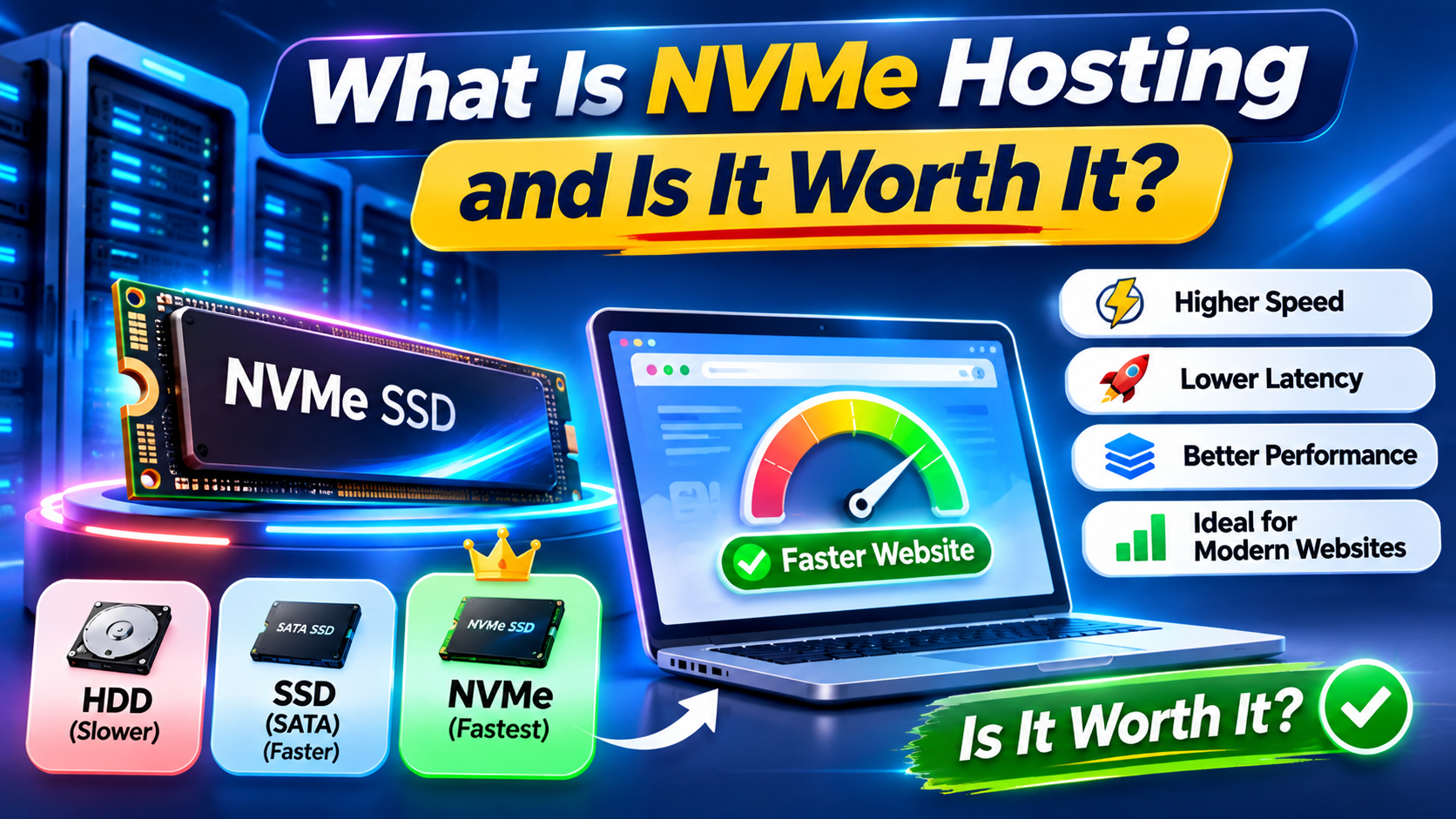
## NVMe vs SATA SSD vs HDD Hosting
Understanding the differences between storage technologies can help you choose the right hosting plan.
**HDD Hosting:** Traditional hard disk drives store data on rotating magnetic disks. They are generally slower than SSDs, especially when handling random data requests. HDD hosting may still be suitable for backups, archives, or storage-heavy applications where speed is less important.
**SATA SSD Hosting:** SATA SSDs use flash memory and are significantly faster than traditional HDDs for many everyday workloads. They are a good option for websites that need reliable performance without requiring the highest available storage speeds.
**NVMe Hosting:** NVMe SSDs use the PCIe interface and NVMe protocol. They can offer higher throughput, lower latency, and greater input/output performance than SATA SSDs, depending on the drive and server configuration.
For most modern hosting workloads, both SATA SSD and NVMe storage can provide good performance. NVMe becomes particularly attractive when applications generate frequent storage requests.
## Benefits of NVMe Hosting
There are several reasons why website owners and businesses consider upgrading to NVMe hosting.
### 1. Faster Data Access
NVMe drives can retrieve and write data with very low latency. This can help websites access files and database records faster, especially when storage performance is a bottleneck.
### 2. Better Database Performance
Websites built with WordPress, online stores, membership platforms, and other database-driven applications regularly communicate with databases.
NVMe storage can improve database operations when the workload is limited by storage input/output performance. This may help reduce delays during database-heavy activities.
### 3. Improved Performance Under Workloads
NVMe drives can handle high numbers of input/output operations per second (IOPS). This can benefit servers hosting multiple websites or applications that generate many simultaneous storage requests.
The actual improvement depends on the server hardware, workload, and resource limits assigned to each hosting account.
### 4. Faster File Operations
Tasks such as reading website files, extracting archives, creating backups, and processing large numbers of small files may benefit from faster storage.
This can be useful for developers, hosting resellers, and businesses that regularly manage website files.
### 5. Support for Modern Applications
Modern websites and applications can involve complex databases, caching systems, APIs, and frequent file operations. NVMe storage provides a strong foundation for these workloads, particularly when combined with sufficient CPU and RAM.
## Is NVMe Hosting Worth It?
For many website owners, NVMe hosting is worth considering, but it depends on the type of website and the price difference.
If you operate a WordPress website, online store, business website, or database-driven application, NVMe storage can provide a performance advantage when storage speed is limiting your server.
It may also be valuable for hosting providers that manage multiple websites on shared or reseller hosting servers.
However, upgrading to NVMe hosting does not automatically make every website faster. A poorly optimized website with oversized images, excessive plugins, inefficient code, or inadequate caching may remain slow even on a powerful NVMe server.
If your website receives limited traffic and already performs well on SATA SSD hosting, paying significantly more for NVMe may not deliver a noticeable improvement.
## Who Should Choose NVMe Hosting?
NVMe hosting is particularly suitable for:
- **WordPress websites:** Especially websites with frequent database activity and dynamic content.
- **E-commerce stores:** Online stores that handle product catalogs, customer accounts, orders, and inventory.
- **High-traffic websites:** Websites that need to handle many simultaneous requests, provided the rest of the server can support the workload.
- **Hosting resellers:** Businesses managing multiple customer websites on one server.
- **Developers:** Applications involving databases, file processing, and frequent storage operations.
- **Business websites:** Companies that want modern server infrastructure and room to grow.
For simple websites, blogs, and low-traffic projects, a good-quality SATA SSD hosting plan may still be sufficient.
## What Should You Check Before Buying NVMe Hosting?
Do not choose a hosting provider based only on the word NVMe. Consider the complete hosting environment.
1. **CPU and RAM:** Check the processing power and memory allocated to your hosting account.
2. **Storage capacity:** Make sure the plan provides enough space for your website files, databases, emails, and backups.
3. **Server uptime:** Look for a provider with a reliable infrastructure and transparent uptime information.
4. **Web server technology:** Check whether the provider uses Apache, Nginx, or LiteSpeed and whether its configuration suits your website.
5. **Backup policy:** Confirm how frequently backups are created and how restoration works.
6. **Support quality:** Reliable technical support matters when your website experiences problems.
7. **Resource limits:** Check CPU, RAM, I/O, IOPS, and inode limits rather than assuming that NVMe storage means unlimited performance.
## Final Thoughts
NVMe hosting is a modern storage solution that can offer faster data access, lower latency, and higher input/output performance than traditional SATA SSDs and HDDs. It can be particularly useful for WordPress websites, e-commerce stores, database-driven applications, and hosting businesses.
However, storage speed alone does not determine website performance. CPU, RAM, network quality, caching, software optimization, and server configuration all matter.
If the price difference is reasonable and your website benefits from faster storage, NVMe hosting is a worthwhile upgrade. For smaller websites with modest requirements, a reliable SSD hosting plan may be enough.
The best choice is not necessarily the hosting plan with the fastest advertised storage. It is the one that delivers reliable performance, sufficient resources, good support, and value for your budget.
Website speed plays an important role in the success of any online business. Visitors expect pages to load quickly, and even a small delay can make someone leave before exploring your website. One factor that can influence website performance is the type of storage used by your hosting provider. This is where NVMe hosting comes in.
NVMe hosting is becoming increasingly popular among web hosting companies because it uses modern storage technology designed for high-speed data access. But what exactly is NVMe hosting, how does it work, and is it worth paying extra for?
Let's explore everything you need to know before choosing an NVMe hosting plan.
## What Is NVMe Hosting?
NVMe hosting is a type of web hosting that uses NVMe (Non-Volatile Memory Express) solid-state drives to store website files, databases, emails, and other server data.
Unlike traditional hard disk drives (HDDs), which use moving mechanical parts, NVMe drives use flash memory. They connect through the PCIe interface and communicate with the server using a protocol designed specifically for fast storage devices.
In simple terms, NVMe storage helps a hosting server read and write data much faster than many older storage technologies.
When someone visits your website, the server may need to retrieve images, scripts, database records, and other files. Faster storage can help complete these operations more quickly, particularly when a website performs many storage requests.
## How Does NVMe Hosting Work?
NVMe drives connect to a server through PCIe (Peripheral Component Interconnect Express), a high-speed interface commonly used by modern computer components.
Traditional SATA SSDs use the SATA interface and AHCI protocol, which were originally designed around older storage technology. NVMe was developed to take better advantage of the parallel processing capabilities of flash storage.
This allows NVMe devices to handle many input and output operations simultaneously, with lower protocol overhead and lower latency than traditional SATA storage in many workloads.
For a website, this can be useful when the server frequently accesses databases, reads website files, processes customer requests, or handles multiple users at the same time.
However, NVMe storage is only one part of a hosting server. CPU performance, RAM, network connectivity, server configuration, and software optimization also influence overall website speed.
## NVMe vs SATA SSD vs HDD Hosting
Understanding the differences between storage technologies can help you choose the right hosting plan.
**HDD Hosting:** Traditional hard disk drives store data on rotating magnetic disks. They are generally slower than SSDs, especially when handling random data requests. HDD hosting may still be suitable for backups, archives, or storage-heavy applications where speed is less important.
**SATA SSD Hosting:** SATA SSDs use flash memory and are significantly faster than traditional HDDs for many everyday workloads. They are a good option for websites that need reliable performance without requiring the highest available storage speeds.
**NVMe Hosting:** NVMe SSDs use the PCIe interface and NVMe protocol. They can offer higher throughput, lower latency, and greater input/output performance than SATA SSDs, depending on the drive and server configuration.
For most modern hosting workloads, both SATA SSD and NVMe storage can provide good performance. NVMe becomes particularly attractive when applications generate frequent storage requests.
## Benefits of NVMe Hosting
There are several reasons why website owners and businesses consider upgrading to NVMe hosting.
### 1. Faster Data Access
NVMe drives can retrieve and write data with very low latency. This can help websites access files and database records faster, especially when storage performance is a bottleneck.
### 2. Better Database Performance
Websites built with WordPress, online stores, membership platforms, and other database-driven applications regularly communicate with databases.
NVMe storage can improve database operations when the workload is limited by storage input/output performance. This may help reduce delays during database-heavy activities.
### 3. Improved Performance Under Workloads
NVMe drives can handle high numbers of input/output operations per second (IOPS). This can benefit servers hosting multiple websites or applications that generate many simultaneous storage requests.
The actual improvement depends on the server hardware, workload, and resource limits assigned to each hosting account.
### 4. Faster File Operations
Tasks such as reading website files, extracting archives, creating backups, and processing large numbers of small files may benefit from faster storage.
This can be useful for developers, hosting resellers, and businesses that regularly manage website files.
### 5. Support for Modern Applications
Modern websites and applications can involve complex databases, caching systems, APIs, and frequent file operations. NVMe storage provides a strong foundation for these workloads, particularly when combined with sufficient CPU and RAM.
## Is NVMe Hosting Worth It?
For many website owners, NVMe hosting is worth considering, but it depends on the type of website and the price difference.
If you operate a WordPress website, online store, business website, or database-driven application, NVMe storage can provide a performance advantage when storage speed is limiting your server.
It may also be valuable for hosting providers that manage multiple websites on shared or reseller hosting servers.
However, upgrading to NVMe hosting does not automatically make every website faster. A poorly optimized website with oversized images, excessive plugins, inefficient code, or inadequate caching may remain slow even on a powerful NVMe server.
If your website receives limited traffic and already performs well on SATA SSD hosting, paying significantly more for NVMe may not deliver a noticeable improvement.
## Who Should Choose NVMe Hosting?
NVMe hosting is particularly suitable for:
- **WordPress websites:** Especially websites with frequent database activity and dynamic content.
- **E-commerce stores:** Online stores that handle product catalogs, customer accounts, orders, and inventory.
- **High-traffic websites:** Websites that need to handle many simultaneous requests, provided the rest of the server can support the workload.
- **Hosting resellers:** Businesses managing multiple customer websites on one server.
- **Developers:** Applications involving databases, file processing, and frequent storage operations.
- **Business websites:** Companies that want modern server infrastructure and room to grow.
For simple websites, blogs, and low-traffic projects, a good-quality SATA SSD hosting plan may still be sufficient.
## What Should You Check Before Buying NVMe Hosting?
Do not choose a hosting provider based only on the word NVMe. Consider the complete hosting environment.
1. **CPU and RAM:** Check the processing power and memory allocated to your hosting account.
2. **Storage capacity:** Make sure the plan provides enough space for your website files, databases, emails, and backups.
3. **Server uptime:** Look for a provider with a reliable infrastructure and transparent uptime information.
4. **Web server technology:** Check whether the provider uses Apache, Nginx, or LiteSpeed and whether its configuration suits your website.
5. **Backup policy:** Confirm how frequently backups are created and how restoration works.
6. **Support quality:** Reliable technical support matters when your website experiences problems.
7. **Resource limits:** Check CPU, RAM, I/O, IOPS, and inode limits rather than assuming that NVMe storage means unlimited performance.
## Final Thoughts
NVMe hosting is a modern storage solution that can offer faster data access, lower latency, and higher input/output performance than traditional SATA SSDs and HDDs. It can be particularly useful for WordPress websites, e-commerce stores, database-driven applications, and hosting businesses.
However, storage speed alone does not determine website performance. CPU, RAM, network quality, caching, software optimization, and server configuration all matter.
If the price difference is reasonable and your website benefits from faster storage, NVMe hosting is a worthwhile upgrade. For smaller websites with modest requirements, a reliable SSD hosting plan may be enough.
The best choice is not necessarily the hosting plan with the fastest advertised storage. It is the one that delivers reliable performance, sufficient resources, good support, and value for your budget.